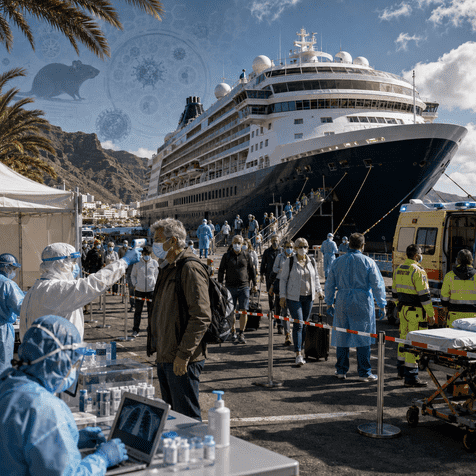
Passengers from the MV Hondius are being treated as high-risk contacts after a rare multi-country cluster linked to the Andes strain left three people dead.

A rare hantavirus outbreak linked to an Atlantic cruise ship has prompted an international public-health operation, with European authorities treating all passengers aboard the MV Hondius as high-risk contacts after several infections and three deaths were reported.
The ship docked near Tenerife in Spain’s Canary Islands on Sunday, May 10, after a cluster of severe illness was identified among passengers who had travelled from Argentina toward Cape Verde. The European Centre for Disease Prevention and Control said all passengers would be managed as high-risk contacts as a precaution, although health authorities stressed that the broader risk to the public remains low.
According to the World Health Organization, eight cases had been reported by May 7, including three deaths, with five infections confirmed at that point. The WHO later linked the cluster to cruise-ship travel and said the response involved coordination among several countries, including Spain, Cape Verde and South Africa.
The outbreak is unusual because the cases are associated with the Andes hantavirus strain, a form historically linked to rodents in parts of South America. Most hantaviruses are transmitted through contact with infected rodents or their droppings, urine or saliva; human-to-human spread is rare. However, the Andes strain is one of the few hantaviruses for which limited person-to-person transmission has been documented, making contact tracing and quarantine measures more urgent.
Passengers disembarking in Tenerife are undergoing medical screening, while countries including the United Kingdom, the United States, France, the Netherlands, Australia and Norway are arranging controlled repatriations. Authorities have sought to avoid commercial travel for passengers and to prevent contact with the local population during transfers.
Despite the seriousness of the cases, public-health agencies have urged calm. The ECDC said earlier in the week that the risk for Europe was “very low,” and experts have emphasized that hantavirus does not spread easily in normal social settings. The main danger is prolonged exposure to contaminated environments or close contact in specific circumstances.
The incident has nevertheless exposed the logistical difficulty of managing rare infectious-disease events in global travel. A cruise ship can connect passengers from dozens of countries, complicating surveillance, quarantine and medical evacuation. In this case, authorities are also tracing people who had already disembarked before the ship reached Tenerife.
For now, the response is focused on containing the cluster, monitoring passengers through the incubation period and determining how the virus reached the vessel. The outbreak is not being treated as a pandemic threat, but it has become a reminder that rare zoonotic diseases can move quickly through international travel networks — and that even low-probability pathogens can demand a rapid, coordinated global response.