The world No. 1’s shock defeat to Sorana Cirstea at the Italian Open has raised fresh doubts over her clay-court form just two weeks before Roland Garros begins.

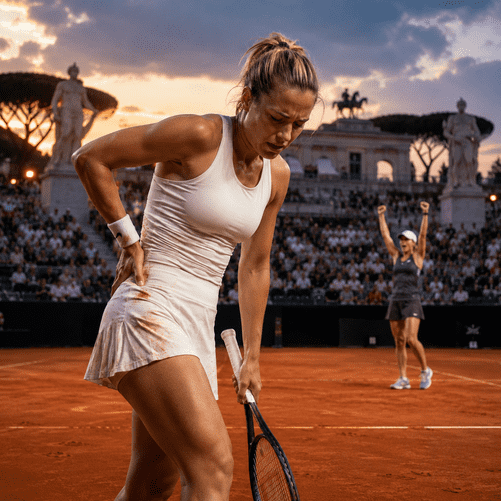
Aryna Sabalenka’s French Open preparations suffered a serious setback in Rome, where the world No. 1 was knocked out of the Italian Open by Sorana Cirstea while struggling with a lower-back and hip problem.
Cirstea, the 36-year-old Romanian veteran, produced one of the biggest wins of her career by defeating Sabalenka 2-6, 6-3, 7-5 in the third round. It was Cirstea’s first career victory over a world No. 1 and one of the most significant results of this year’s clay-court season.
The result was striking not only because of the ranking gap, but because Sabalenka had appeared in control early in the match. After taking the first set, she lost momentum as Cirstea grew more aggressive and composed. Sabalenka later needed treatment late in the contest and said physical limitations affected her movement and shot rotation.
The defeat is Sabalenka’s second in three matches, following her quarter-final loss to Hailey Baptiste at the Madrid Open. For a player who began the season strongly, the sudden disruption on clay has changed the tone of her Roland Garros campaign from expectation to uncertainty.
The French Open begins on May 24, 2026, giving Sabalenka roughly two weeks to recover before the year’s second Grand Slam. Reuters reported that she will now focus on shaking off the injury in time for Paris, where clay-court movement, endurance and core rotation are essential to surviving long matches.
For Cirstea, the victory was a reminder of the danger experienced players can pose in major tournaments, especially when they are willing to attack under pressure. For Sabalenka, it was a warning that dominance on hard courts does not automatically transfer to clay, where patience, balance and physical resilience often decide the biggest matches.
The wider women’s draw now looks more open. If Sabalenka arrives in Paris below full fitness, rivals will see an opportunity to challenge the top seed before she can build rhythm. Her power remains one of the sport’s most intimidating weapons, but in Rome, the match showed how quickly that advantage can narrow when movement becomes compromised.
Sabalenka’s next challenge is no longer only tactical. It is medical, physical and psychological. Paris may still offer her a chance to reassert control over the season, but after Rome, her path to Roland Garros has become far more complicated.