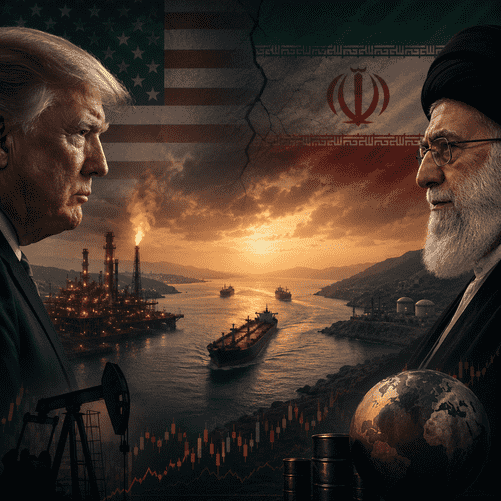
Washington’s rejection of Tehran’s latest response has pushed oil prices higher and renewed fears that the Strait of Hormuz crisis could deepen into a wider economic and security shock.

Diplomatic efforts to end the U.S.-Iran conflict suffered a fresh setback after President Donald Trump rejected Tehran’s response to a U.S. peace proposal, calling it “unacceptable.” The rejection has left negotiations at an impasse and immediately unsettled energy markets, with traders again pricing in the risk of prolonged disruption around the Strait of Hormuz, one of the world’s most important oil and gas corridors. Brent crude rose above $103 a barrel, while U.S. West Texas Intermediate climbed close to $98, according to Reuters.
The Strait of Hormuz is the strategic heart of the crisis. Before the latest conflict, roughly a fifth of global oil flows moved through the narrow waterway linking the Gulf to the Arabian Sea. Any sustained restriction there can affect energy prices far beyond the Middle East, raising transport costs, insurance premiums and inflation expectations across Asia, Europe and North America. AP reported that Saudi Aramco has been redirecting some exports through its East-West Pipeline to the Red Sea, but that route cannot fully replace normal Gulf flows.
The diplomatic dispute centers on the conditions for ending the war. Washington’s proposal reportedly sought to reopen shipping routes, begin nuclear discussions and reduce the risk of further military escalation. Tehran, however, has accused the United States of making “unreasonable demands,” while resisting terms that would sharply limit its nuclear infrastructure and regional leverage. The result is a negotiation process that remains active in form, but increasingly frozen in substance.
The security situation is also deteriorating at sea. Qatar condemned a drone attack on a commercial cargo ship in its territorial waters near Mesaieed Port, saying the vessel had been travelling from Abu Dhabi when it was struck. Qatari authorities said the attack caused a small onboard fire but no injuries, describing the incident as a violation of freedom of navigation and international law.
That incident has heightened concerns that the Gulf’s fragile ceasefire could unravel through maritime escalation rather than a direct battlefield confrontation. Al Jazeera reported that the attack near Qatar came as Kuwait and the United Arab Emirates also reported drone-related security incidents, underlining how regional tensions are spreading across commercial and energy infrastructure.
The economic consequences are already visible. Higher oil prices threaten to complicate the fight against inflation at a moment when major central banks are debating when, or whether, to cut interest rates. Reuters reported that gold fell as oil-driven inflation concerns increased expectations that borrowing costs could remain elevated for longer.
For Gulf states, the crisis presents a difficult balancing act. They want to protect shipping lanes, maintain investor confidence and avoid being pulled deeper into a U.S.-Iran confrontation. But the drone strike near Qatar shows how hard it is to insulate regional economies from a conflict that directly affects ports, pipelines, tankers and insurance markets.
For Washington, the challenge is equally complex. The United States must pressure Tehran without triggering a wider regional war or a longer energy shock. Trump is also expected to discuss Iran with Chinese President Xi Jinping, according to Reuters, reflecting the fact that Beijing’s role as a major energy buyer gives it influence over the diplomatic and economic dimensions of the crisis.
The danger now is that diplomacy, maritime security and energy markets begin reinforcing one another in a negative cycle. Failed talks push oil higher; higher oil prices increase global political pressure; maritime attacks raise insurance and shipping costs; and every new incident makes compromise harder.
For now, the crisis remains unresolved. But the latest rejection of Iran’s response has made one point clear: the Gulf is no longer facing a contained diplomatic dispute. It is facing a security and economic test whose consequences could reach every major economy dependent on stable energy flows.