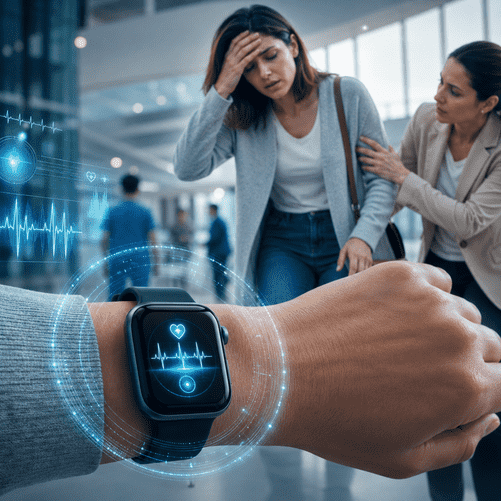
A Korean clinical trial found that a smartwatch could anticipate fainting episodes up to five minutes in advance, signaling a new phase in the race to turn consumer devices into early-warning health tools.

Samsung has reported a major step forward in wearable health technology after a joint clinical study in South Korea showed that a Galaxy Watch could predict vasovagal syncope — commonly known as fainting — before an episode occurred.
The study, conducted with Chung-Ang University Gwangmyeong Hospital, used biosignals collected from a Galaxy Watch6 to detect early signs of vasovagal syncope. Samsung said the system analyzed heart-rate variability data from the watch’s photoplethysmography sensor using an artificial-intelligence algorithm, predicting impending fainting episodes up to five minutes in advance with 84.6% accuracy, 90% sensitivity and 64% specificity.
The research involved 132 patients with suspected symptoms who underwent induced fainting tests while wearing the smartwatch. The findings were also described in a peer-reviewed paper in European Heart Journal – Digital Health, which said researchers used Galaxy Watch6 multiwavelength PPG data and machine-learning classification to identify signs of neurally mediated syncope.
The significance lies in the potential shift from passive health tracking to preventive alerts. Most smartwatches today monitor heart rate, sleep, blood oxygen, physical activity and, in some markets, ECG or blood-pressure-related features. A fainting-warning system would move the device closer to real-time risk prediction, giving users time to sit down, lie down or call for help before losing consciousness.
Vasovagal syncope is usually not life-threatening, but the fall that follows can cause serious secondary injuries such as fractures or concussions. Samsung cited Chung-Ang University professor Junhwan Cho as saying that up to 40% of people experience vasovagal syncope during their lifetime, with about one-third experiencing recurrent episodes.
The announcement also reflects a larger trend in consumer technology: the smartwatch is becoming less of a smartphone accessory and more of a health platform. Apple, Samsung, Google, Huawei and other wearable makers are increasingly competing on medical-adjacent functions, from arrhythmia warnings to sleep analysis, stress monitoring and fitness recovery metrics.
But the technology is not yet ready to be treated as a medical guarantee. The study was conducted in controlled clinical conditions, not in the unpredictable environment of daily life. It also involved a limited patient group, and Samsung has not announced the feature as an immediately available consumer tool. Independent coverage has noted that the results are promising but should not be confused with proof that today’s watches can reliably warn every user before a fainting episode.
Regulation will be another major hurdle. Any feature that claims to predict fainting or prevent injury could face scrutiny from health authorities, especially if marketed as a medical function rather than a general wellness tool. Companies will need to prove accuracy across larger and more diverse populations, including different ages, skin tones, health conditions and real-world movement patterns.
Still, the direction of travel is clear. Wearables are moving from counting steps to interpreting biological risk. If Samsung and its research partners can validate the system outside the laboratory, the next generation of smartwatches may not only tell users what happened to their bodies — they may warn them about what is about to happen.