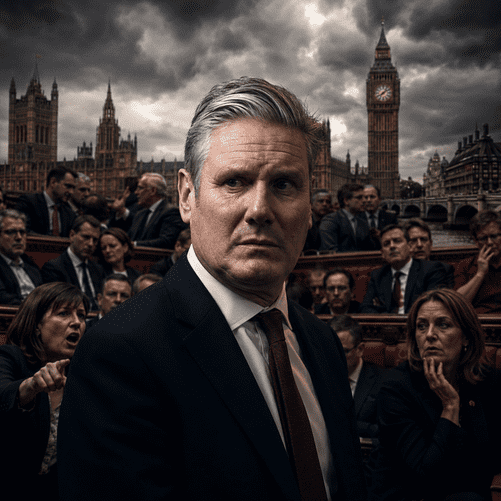
Less than two years after a landslide victory, the British prime minister faces pressure from within his own party as economic frustration, migration concerns and strained public services fuel voter anger.

British Prime Minister Keir Starmer is battling to preserve his authority after dozens of Labour lawmakers called for him to resign, deepening a political crisis that has shaken the government less than two years after its sweeping 2024 election victory.
The pressure follows heavy Labour losses in local and regional elections, which have intensified doubts inside the party over Starmer’s ability to lead it into the next national contest. Reuters reported that around 90 Labour lawmakers have called for him to step down, though no formal leadership challenge has yet been triggered.
Starmer has rejected calls to quit, insisting that his government must continue with its reform program rather than return Britain to what he described as political instability. His administration is preparing a legislative package of more than 35 bills and draft bills focused on the economy, national security and public-sector reform.
The timing is politically delicate. King Charles is due to deliver the State Opening of Parliament speech, a ceremonial moment that normally allows a government to present its priorities for the year ahead. But this year, the speech risks being overshadowed by questions over whether Starmer will remain in office long enough to deliver the program written in his name.
The internal revolt reflects a wider collapse in public confidence. Reuters analysis points to several sources of voter frustration, including the cost of living, sticky inflation, high taxes, immigration pressures, strained public services and dissatisfaction with local government. Britain’s exposure to gas prices has also left its economy especially vulnerable to the consequences of the Iran war and wider energy-market instability.
For many Labour lawmakers, the fear is not only that Starmer has become unpopular, but that the party’s historic 2024 majority could be eroded before the next general election. The rise of Nigel Farage’s Reform UK has added pressure on Labour from the right, particularly over immigration and asylum policy, while disillusioned progressive voters have criticized the government for moving too cautiously on public investment and social reform.
Potential successors are already being discussed in Westminster. Health Secretary Wes Streeting is widely seen as a possible centrist challenger, while Manchester Mayor Andy Burnham remains influential among Labour members despite not currently being a member of parliament. Former deputy prime minister Angela Rayner, Home Secretary Shabana Mahmood and junior defence minister Al Carns have also been mentioned in leadership speculation.
Still, Starmer’s position has not collapsed. His allies argue that there is no clear alternative with enough parliamentary support to force a leadership contest. Europe minister Nick Thomas-Symonds said no candidate appeared to have the backing required to trigger a challenge, urging the party to move on.
The crisis exposes the central dilemma facing Britain’s government: Labour was elected on a promise of stability and renewal after years of Conservative turmoil, but voters are now demanding faster results. Hospital waiting lists remain above pre-pandemic levels, local services are under pressure, and household finances continue to be squeezed by inflation and borrowing costs.
Starmer’s immediate task is to survive the coming days without a formal challenge. His larger challenge is harder: to convince voters and his own party that his government can still deliver meaningful change before political impatience turns into open rebellion.
For Britain, the episode marks another chapter in a decade of instability since the Brexit referendum. Starmer entered office promising to end that cycle. Now, his premiership has become the latest test of whether any British leader can govern long enough — and decisively enough — to restore public trust.