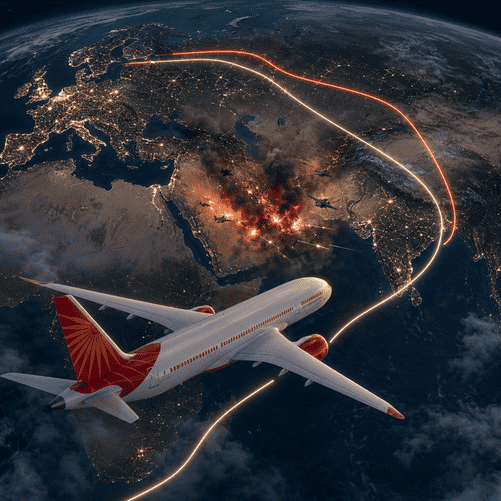
The disruption is reshaping Europe–Asia travel, raising airline costs, and exposing how quickly regional wars can ripple across global transport networks.

Air India has announced a temporary reduction in international flights between June and August, as the widening conflict in the Middle East forces airlines to navigate longer routes, higher fuel bills, and tighter airspace restrictions. The move affects several long-haul services linking India with North America, Europe, and Asia, underscoring how a regional security crisis can quickly become a global aviation problem.
According to the airline’s latest plans, services including Delhi–Chicago, Mumbai–New York, and Delhi–Shanghai are expected to be suspended, while flights to key European destinations such as Paris, Milan, and Rome will be reduced in frequency. Air India said it still intends to operate more than 1,200 international flights per month, but full restoration will depend on the security situation and the reopening of viable air corridors.
The cuts come at a sensitive moment for Europe–Asia connectivity. Airlines flying between South Asia, Europe, and North America have already faced operational pressure from restricted airspace, including Pakistan’s ban on Indian carriers. The latest conflict-related closures in the Middle East further complicate flight planning, forcing aircraft onto longer paths that consume more fuel and reduce scheduling flexibility.
The economic impact extends beyond passengers. Longer routes raise costs for airlines at a time when jet fuel prices are already under pressure from instability around critical maritime and energy corridors, including the Strait of Hormuz. Recent market reporting has also pointed to oil price sensitivity as investors track risks to traffic through the Strait.
For Europe, the disruption is another reminder of its exposure to crises beyond its borders. The bloc’s transport, energy, and industrial sectors are increasingly affected by geopolitical shocks stretching from Eastern Europe to the Middle East and Asia. In the chemicals sector, for example, European producers have recently seen a temporary competitive advantage as conflict-related supply disruptions hit Asian rivals more heavily.
For India, the timing is also significant. Air India is in the middle of a major international expansion and fleet modernization effort under Tata ownership, with Singapore Airlines holding a minority stake. The route reductions show how even ambitious growth strategies remain vulnerable to geopolitical volatility, especially when airspace access, fuel costs, and regional security deteriorate at the same time.
The broader message is clear: Europe–Asia mobility is becoming more fragile. What once looked like a commercial aviation issue is now tied closely to war risk, energy markets, diplomatic tensions, and strategic chokepoints. Until airspace restrictions ease and Middle East tensions stabilize, passengers and companies relying on Europe–Asia routes may face higher fares, longer journeys, and fewer direct connections.