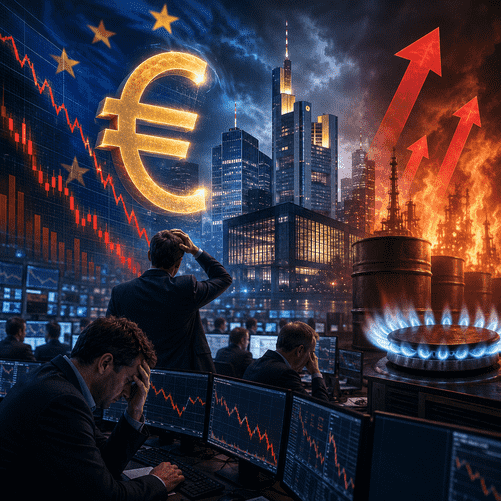
Rising energy prices, higher bond yields and renewed geopolitical uncertainty are forcing investors to reconsider whether Europe’s inflation crisis is truly over

European markets came under renewed pressure on Friday as a fresh inflation shock revived concerns that the eurozone may be entering a more difficult phase: one marked by higher energy costs, fragile growth and renewed pressure on the European Central Bank to tighten monetary policy.
The pan-European STOXX 600 fell by around 1.4%, with technology, materials, banks and luxury stocks among the weakest sectors. Germany’s DAX, France’s CAC 40 and Spain’s IBEX also moved lower, reflecting a broader retreat from risk across European equities. The selloff came as investors reacted to the possibility that inflation, previously expected to move steadily back toward the ECB’s target, may instead remain elevated for longer.
The latest inflation data strengthened those concerns. Eurostat’s flash estimate showed euro-area annual inflation rising to 3.0% in April 2026, up from 2.6% in March, moving further above the ECB’s 2% medium-term target. Energy was the main driver, with energy inflation accelerating sharply to 10.9%, compared with 5.1% in March. Services inflation remained relatively high at 3.0%, while food, alcohol and tobacco rose 2.5%.
The renewed inflation pressure has been closely linked to energy markets and geopolitical tension. Oil prices have risen sharply amid fears of supply disruption connected to the conflict involving Iran, intensifying concerns that higher fuel and transport costs could pass through to consumers and businesses across Europe. Reuters reported that the inflation shock has also contributed to a global bond selloff, with European, U.S., U.K. and Japanese yields all moving higher as investors reassess the outlook for interest rates.
For the ECB, the timing is especially difficult. At its latest policy meeting on April 30, 2026, the Governing Council kept its three key interest rates unchanged, but warned that upside risks to inflation and downside risks to growth had intensified. The central bank said it would continue to follow a data-dependent, meeting-by-meeting approach as it tries to bring inflation back to target without causing unnecessary damage to the economy.
The dilemma is becoming sharper. Higher interest rates can help contain inflation by cooling demand, but they also increase borrowing costs for households, companies and governments. That matters in a eurozone economy already facing pressure from weak consumer confidence, expensive energy, trade uncertainty and uneven industrial performance. A more aggressive ECB response could stabilize inflation expectations, but it could also deepen the slowdown in countries already struggling with low growth.
Markets are now watching bond yields as closely as stock prices. Rising yields on German Bunds and Italian government bonds suggest investors are demanding higher returns to hold European debt, partly because inflation is eroding the value of fixed-income assets. Higher government borrowing costs could also complicate fiscal policy, especially for more indebted eurozone members that may need to support households and businesses if energy prices remain high.
The inflation psychology is also changing. ECB survey data cited by Reuters showed eurozone consumers sharply lifting their inflation expectations, with one-year expectations rising to 4.0% in March from 2.5% a month earlier. That matters because central banks fear that once households and businesses expect higher inflation, wage demands and pricing decisions can make inflation more persistent.
Corporate Europe is now facing a more complex outlook. Energy-intensive industries could see margins squeezed again, exporters may suffer if weaker global demand combines with higher production costs, and banks face a mixed picture: higher rates can support lending margins, but they can also increase credit risk if households and companies struggle to repay debt. Luxury and technology shares, which are more sensitive to global demand and interest-rate expectations, were among the sectors hit in the latest market decline.
For consumers, the risk is that inflation returns through everyday costs: fuel, heating, electricity, transport and food distribution. Even if core inflation remains more contained than during the previous energy crisis, another spike in energy prices could delay the recovery in real incomes. That would place additional pressure on governments, which may be forced to choose between fiscal restraint and targeted support for vulnerable households.
The broader market message is clear: investors no longer view the eurozone inflation story as safely resolved. April’s data showed that energy prices can still rapidly reverse the disinflation trend, while the ECB’s cautious stance reflects the danger of acting too quickly or too slowly. In the coming weeks, the direction of European markets will likely depend on three factors: whether oil prices stabilize, whether inflation expectations continue to rise, and whether the ECB signals that rate hikes are back on the table.