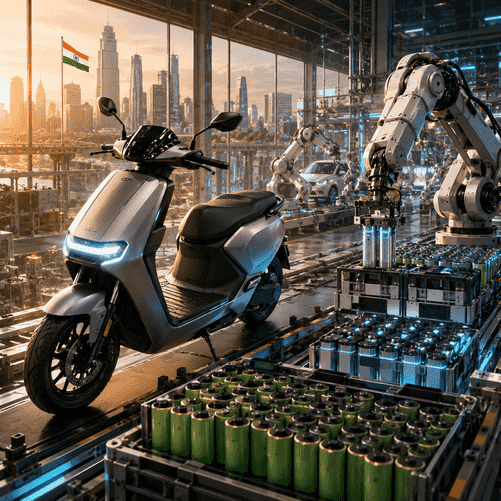
The SoftBank-backed company will invest more than $200 million in electric-vehicle and cell technology units as competition intensifies in one of the world’s most important two-wheeler markets.

Ola Electric has approved an investment of 20 billion rupees, or about $208.5 million, into its electric-vehicle and battery-cell businesses, marking a major push to strengthen its position in India’s fast-growing but increasingly competitive EV market. The company plans to make the investment by May 14, 2027, with funds directed toward automation, localized battery production and new lower-cost electric two-wheelers.
The decision comes at a critical moment for the Indian EV sector. India is one of the world’s largest two-wheeler markets, and electric scooters have become a key battleground for manufacturers seeking to capture urban commuters looking for cheaper, cleaner alternatives to petrol-powered vehicles. But Ola Electric, once a dominant player in India’s e-scooter segment, now faces stronger competition from established manufacturers including Bajaj Auto, TVS Motor and Ather Energy.
At the center of Ola’s strategy is battery localization. By producing more of its own battery cells, the company aims to reduce reliance on external suppliers, lower costs and improve margins. That is especially important in the EV industry, where batteries remain one of the most expensive components of a vehicle and where supply-chain control can determine profitability.
The investment also reflects a broader global shift in the EV market. Demand for electric vehicles rose for a second consecutive month in April, with battery-electric and plug-in hybrid registrations increasing 6% year on year to 1.6 million units, according to data cited by Reuters from Benchmark Mineral Intelligence. Even so, the market remains uneven, with demand affected by fuel prices, subsidies, charging infrastructure and competition from lower-cost Chinese manufacturers.
For Ola Electric, the immediate challenge is not only to sell more scooters, but to prove that it can build a sustainable business model. The company has previously projected operating cost reductions of up to 50% in coming quarters, after reporting a narrower third-quarter loss. Its EV unit generated 47.17 billion rupees in revenue in the fiscal year ending March 31, 2026, while its cell unit posted 730 million rupees.
The move could help Ola defend market share at home and position itself for longer-term growth as governments and consumers push transportation toward electrification. But the company’s success will depend on whether localized batteries, automation and cheaper models can translate into reliable products at competitive prices.
India’s EV market is no longer a race led by early movers alone. It is entering a more difficult phase, where scale, technology, cost control and brand trust will decide the winners. Ola Electric’s investment is a clear signal that the company sees batteries not just as a component, but as the foundation of its next battle for survival and growth.