New data shows electric-vehicle demand rising for a second consecutive month, even as China and North America slow and Europe becomes the sector’s strongest growth engine.

Global demand for electric vehicles is rising again, signaling that the transition away from combustion-engine cars remains resilient despite uneven policy support, trade tensions and pressure on automakers.
Registrations of new battery-electric vehicles and plug-in hybrids rose 6% year-on-year in April, reaching 1.6 million vehicles, according to data from Benchmark Mineral Intelligence reported by Reuters. The increase marked the second straight monthly rise in global EV demand, although registrations were still 9% lower than March’s record monthly level.
The rebound is being driven by a combination of high petrol prices, policy incentives and the growing international presence of Chinese automakers. Benchmark Mineral Intelligence said demand continues to be supported by fuel costs and expanding Chinese original-equipment-manufacturer activity abroad. The oil-market disruption caused by the Middle East conflict has also strengthened the economic case for electric mobility in countries exposed to higher fuel prices.
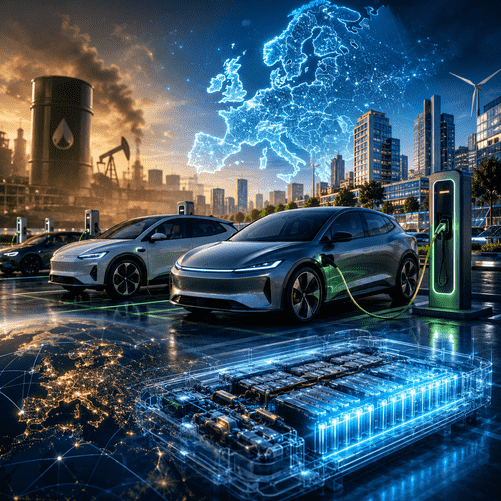
Europe has emerged as the clearest bright spot. EV registrations in the region rose 27% in April to roughly 400,000 units, far outpacing global growth. The region’s momentum reflects both consumer demand and a larger industrial push to secure its place in the electric-vehicle supply chain.
That industrial race is accelerating. A recent study cited by Reuters found that countries in the European Economic Area and Switzerland have committed nearly €200 billion to the EV ecosystem, including €109 billion for battery supply chains, €60 billion for EV manufacturing, and up to €46 billion for public charging networks. Europe now produces batteries for roughly one in three EVs sold domestically, though analysts warn the region still needs more stable energy costs, subsidies and protection to compete globally.
The picture is more complicated in China and North America. In China, April EV registrations fell 8% from a year earlier to around 850,000 vehicles after support for auto trade-ins was withdrawn and a tax break on EV purchases expired. But Chinese manufacturers continued to expand abroad, exporting more than 400,000 electric vehicles in April alone. In North America, EV registrations dropped 28% to about 120,000 units, following the end of a U.S. tax-credit scheme and looser emissions-rule proposals from the Trump administration.
Behind the sales data, the technology race is intensifying. Chinese battery leader CATL recently unveiled a lighter next-generation Qilin battery designed to deliver a 1,000-kilometer range, alongside an upgraded Shenxing battery capable of charging from 10% to 98% in under seven minutes. The company also plans mass delivery of sodium-ion batteries in the fourth quarter, positioning itself for a broader shift in battery chemistry and supply security.
Europe is also trying to build its own industrial base. Poland’s state-backed ElectroMobility Poland has partnered with Taiwan’s Foxconn to develop an EV production and research hub in southern Poland, with production targeted for 2029 and an initial capacity of about 100,000 cars per year. The project is intended to serve the wider European market and strengthen local expertise in software, data analytics and digital mobility.
The latest data suggests the EV market is not moving in a straight line. Demand is rising globally, but growth is increasingly shaped by fuel prices, national subsidies, battery innovation and industrial policy. Europe is gaining speed, China is exporting aggressively despite softer domestic demand, and North America is losing momentum as policy support weakens.
For automakers, battery companies and governments, the message is clear: the EV transition is still advancing, but the next phase will be less about early adoption and more about scale, affordability, charging infrastructure and control over the battery supply chain.