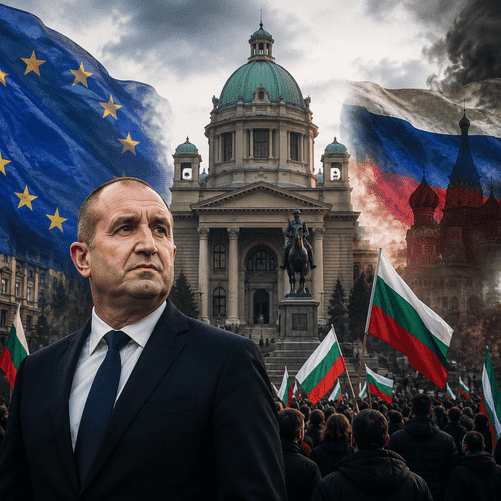
Rumen Radev’s return to power could pull Sofia closer to Moscow, creating new uncertainty for the EU and NATO at a sensitive moment for the continent.

SOFIA — Bulgaria has entered a new political chapter after former president Rumen Radev, a Kremlin-friendly eurosceptic, moved to form a new government following a decisive parliamentary election victory. His return to power is being closely watched in Brussels because Bulgaria is both a member of the European Union and NATO, and its political direction matters for Europe’s security strategy in the Black Sea region.
Radev’s Progressive Bulgaria party won 44.6% of the vote in the April 19 parliamentary election, giving it a majority in the 240-seat legislature. The result marked one of Bulgaria’s strongest single-party performances in years and followed a long period of political instability, including repeated elections and public frustration over prices, corruption and weak governance.
After receiving the mandate to form a government, Radev promised to lower prices and restore stability. His message appears aimed at voters exhausted by economic pressure and years of coalition deadlock. But his political profile has raised concern among European partners, especially because Bulgaria has been strategically important in debates over Ukraine, energy security and NATO’s eastern posture.
The shift in Sofia could complicate EU unity at a time when Europe is already managing war-related pressures, rising defence spending and fragile public finances across parts of Eastern Europe. Reuters has reported that political instability, energy costs and fiscal strain are already weighing on the region, with Romania’s recent government collapse adding to investor concern.
For Brussels, the key question is whether Radev’s government will remain inside the European mainstream or pursue a more confrontational line on Russia, sanctions and EU policy. Even a modest change in Bulgaria’s stance could matter, because EU foreign policy decisions often require unity, and any member state can slow or weaken collective action.
Bulgaria’s domestic agenda will also be difficult. Radev has promised economic relief, but lower prices are hard to deliver quickly, especially in a country exposed to energy costs and regional instability. If expectations rise faster than results, the new government could face the same public frustration that weakened its predecessors.
The election result shows how Europe’s political map is being reshaped not only by ideology, but by fatigue: voters are demanding stability, cheaper living costs and stronger leadership. In Bulgaria, that demand has returned a Moscow-friendly figure to the center of power — and placed another test in front of the European Union’s fragile political unity.