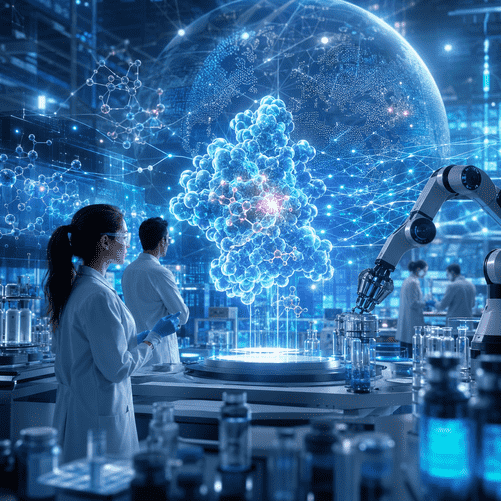
Google-backed Isomorphic Labs has raised $2.1 billion to expand its artificial intelligence platform, signaling a new phase in the race to design medicines faster and more cheaply.

Artificial intelligence is moving deeper into the pharmaceutical industry, as Google-backed Isomorphic Labs raises $2.1 billion to scale its AI-driven drug discovery platform and accelerate the development of new medicines. The funding marks one of the strongest signs yet that AI is shifting from experimental research tool to a serious industrial force in life sciences.
Isomorphic Labs was created from the same scientific ecosystem behind AlphaFold, the AI system that transformed protein-structure prediction. Its goal is broader: to use machine learning to design potential drug candidates, predict how molecules interact with biological targets and reduce the time needed to move from early discovery to clinical development.
The investment comes as major technology companies and pharmaceutical groups intensify their push into AI-powered biology. Amazon recently launched Amazon Bio Discovery, an AI application designed to help scientists run complex early-stage drug discovery workflows without writing code. OpenAI has also introduced GPT-Rosalind, a life-sciences model intended to support research in biochemistry, drug discovery and translational medicine.
The attraction is clear. Traditional drug development is slow, expensive and risky, often taking years before a promising molecule reaches human trials. AI systems could help researchers screen vast chemical libraries, identify promising compounds earlier and eliminate weak candidates before costly laboratory testing begins.
Industry leaders are already describing the impact in concrete terms. Johnson & Johnson has said it is using AI to cut by half the time needed to generate new drug-development leads, illustrating how quickly the technology is becoming embedded inside pharmaceutical research pipelines.
Still, AI drug discovery faces an important test: prediction is not the same as proof. A molecule designed by software must still survive laboratory validation, animal testing, clinical trials, regulatory review and real-world safety monitoring. Many AI-generated candidates may fail, just as conventional drugs do.
But the scale of the latest investment shows that the industry believes the model is changing. The next phase of pharmaceutical competition may not be defined only by laboratory chemistry, but by data, algorithms and biological simulation.
If successful, AI-driven discovery could shorten development timelines, reduce costs and open the door to treatments for diseases that have long resisted traditional methods. For patients, the promise is simple but profound: medicines designed faster, with better targeting, and potentially for conditions that today remain without effective therapy.