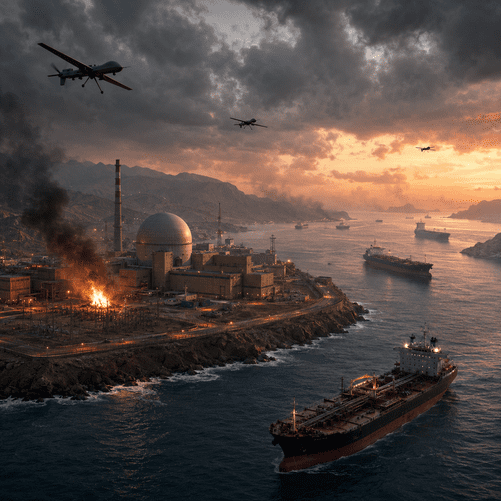
The attack caused a fire at the Barakah nuclear plant’s outer perimeter, intensifying fears that the conflict around Iran is spreading to critical Gulf infrastructure.

A drone strike on the United Arab Emirates’ Barakah nuclear power plant has added a dangerous new dimension to the ongoing Iran war, raising fears that energy and nuclear infrastructure across the Gulf could become targets as diplomatic efforts remain stalled.
UAE authorities said the strike caused a fire at an electric generator on the outer perimeter of the Barakah facility, but reported no injuries and no radiological damage. The International Atomic Energy Agency said radiation levels remained safe and called for restraint around nuclear facilities.
The incident comes amid a fragile and increasingly uncertain ceasefire between the United States, Israel and Iran. Although large-scale fighting has slowed since April, skirmishes continue around the Strait of Hormuz, one of the world’s most important oil-shipping corridors. Saudi Arabia also reported intercepting drones entering from Iraqi airspace, suggesting that the conflict is still spilling across the region through proxy networks and unmanned attacks.
The Barakah incident is significant not because it caused a nuclear emergency, but because of what it represents. A strike near a nuclear facility, even without radiation leakage, sends a message that the region’s most sensitive infrastructure is no longer beyond the reach of the conflict. For Gulf states, which rely on energy exports, ports, refineries and strategic industrial sites, the risk is no longer theoretical.
The broader war has already imposed heavy costs on the global economy. Reuters reported that the conflict has cost global companies at least $25 billion, with airlines, manufacturers and petrochemical-dependent industries hit by higher energy prices, disrupted shipping and strained supply chains. Oil prices have climbed above $100 per barrel as uncertainty around Hormuz continues to pressure markets.
Diplomatic efforts remain difficult. Washington has demanded that Iran dismantle its nuclear program and restore normal passage through the Strait of Hormuz, while Tehran is seeking an end to blockades and compensation for war damage. Earlier talks reportedly aimed at a temporary framework to halt the conflict, reopen Hormuz traffic and create a 30-day window for broader negotiations, but progress has remained fragile.
The strike also increases pressure on Gulf governments to respond without triggering a wider escalation. The UAE condemned the attack and reserved the right to respond, but any direct retaliation could further complicate efforts to stabilize the region.
For now, the Barakah plant appears safe. The political signal, however, is far more serious: the Iran war is no longer confined to battlefields, bases or shipping lanes. It is now threatening the infrastructure that underpins the Gulf’s energy security — and, by extension, the stability of the global economy.