Brussels is preparing rules that could force companies in strategic sectors to diversify suppliers, marking a sharper European response to Beijing’s dominance in critical components.

The European Union is preparing a new push to reduce its dependence on Chinese suppliers, in a move that could reshape trade relations between Europe and Asia and deepen tensions with Beijing.
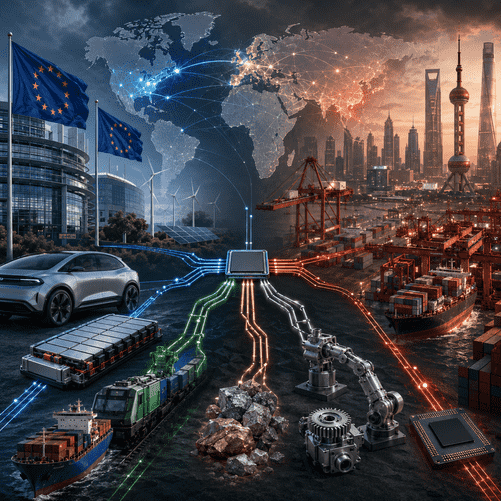
According to reports published Monday, May 18, Brussels is considering rules that would require companies in critical sectors to buy components from several suppliers rather than relying heavily on one country. The plan would reportedly limit sourcing from any single supplier to around 30–40% and require companies to use at least three suppliers based in different countries.
The proposal reflects growing concern in Europe that strategic industries remain too exposed to China, particularly in areas such as industrial machinery, chemicals, electric vehicles, semiconductors and critical minerals. China dominates parts of the global supply chain for rare earths and other materials essential for advanced manufacturing, clean energy and defense production.
The move also comes after recent disruptions linked to Chinese export restrictions on rare earth magnets, which have affected European car manufacturers and intensified calls for supply-chain security. For EU policymakers, the issue is no longer only economic efficiency, but resilience: Europe wants to avoid a situation in which a trade dispute or geopolitical crisis can interrupt production across key sectors.
Brussels is also weighing a tougher trade stance more broadly. EU Trade Commissioner Maroš Šefčovič is reportedly considering tariffs on some Chinese imports, as the bloc seeks to respond to what it sees as unfair competition, subsidies and a growing trade imbalance with China.
For Beijing, the European initiative is likely to be viewed as another step toward economic containment. China has already pushed back against EU scrutiny, including by ordering Chinese entities not to cooperate with a European anti-subsidy investigation into security equipment maker Nuctech.
The proposed supplier-diversification rules are still at an early stage and are expected to be discussed by the European Commission later this month. If adopted, they could become one of the EU’s most direct attempts yet to reduce strategic dependence on China while preserving access to Asian markets.
The message from Brussels is clear: Europe is not seeking to cut commercial ties with China entirely, but it wants fewer single points of failure. In an increasingly fragmented global economy, supply chains are becoming instruments of power — and Europe is trying to make sure it is not left vulnerable.