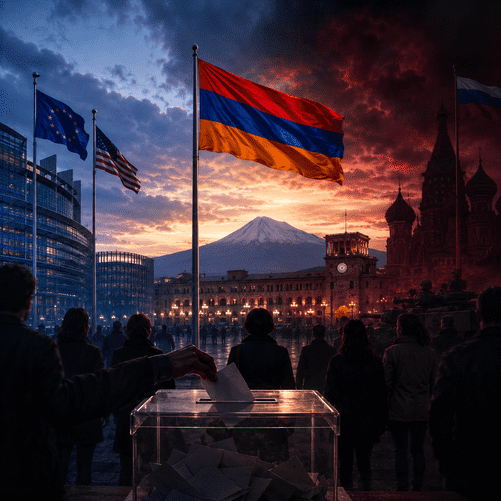
The June 7 parliamentary vote will pit Prime Minister Nikol Pashinyan’s Western-leaning government against pro-Russian opposition forces, with regional security and national identity at stake.

YEREVAN — Armenia is heading toward a pivotal parliamentary election that could reshape its foreign policy and redefine its place between Russia, Europe and the wider West.
The vote, scheduled for June 7, 2026, will see Prime Minister Nikol Pashinyan’s Civil Contract party face a fragmented opposition, including several parties that favor closer alignment with Moscow. The election comes after years of turbulence following Armenia’s defeat in Nagorno-Karabakh and growing public frustration over security, sovereignty and relations with Russia.
For decades, Armenia relied heavily on Russia as its main security partner. But that relationship has deteriorated sharply since Azerbaijan’s military victories in and around Nagorno-Karabakh, when many Armenians accused Moscow of failing to protect its ally. Pashinyan’s government has since moved cautiously but visibly toward the West, deepening contacts with the European Union and the United States while questioning Armenia’s dependence on Russian-led security structures.
The election is therefore more than a domestic contest. It is a geopolitical referendum on whether Armenia should continue its gradual pivot away from Moscow or return to a more traditional Russian orbit.
The opposition is expected to frame Pashinyan as the leader who weakened Armenia’s security position, especially after the loss of Nagorno-Karabakh. His supporters, however, argue that Armenia’s old security model had already failed and that the country must diversify its alliances to survive in a changing region.
The stakes are high beyond Armenia’s borders. A Western-leaning victory would strengthen Europe’s diplomatic footprint in the South Caucasus, a strategically important corridor between the Black Sea, the Caspian region, Russia, Iran and Turkey. A strong showing by pro-Russian forces, meanwhile, could slow or reverse Armenia’s diplomatic reorientation.
The campaign is likely to focus on national security, relations with Azerbaijan, the future of peace negotiations, economic hardship and the role of foreign powers in Armenian politics. Russia will be watching closely, as will Brussels, Washington, Ankara and Baku.
For voters, the choice is deeply personal as well as political. Armenia is still processing the trauma of territorial loss, displacement and a painful reassessment of who its real partners are. The June election will not solve those questions overnight, but it may decide the direction in which the country tries to answer them.