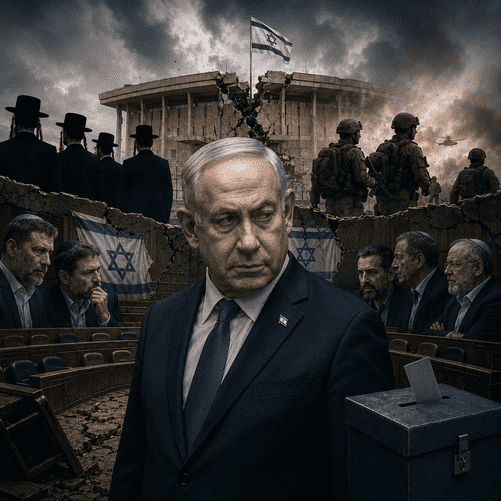
A dispute over ultra-Orthodox military exemptions could bring down parliament months ahead of schedule, opening a new phase of political uncertainty during wartime.

Israel is moving toward a possible early election after lawmakers prepared to vote on a bill that would dissolve the Knesset, threatening Prime Minister Benjamin Netanyahu’s already fragile coalition.
The vote is being driven by a rupture between Netanyahu and a key ultra-Orthodox political ally over military service exemptions for religious seminary students. The issue has long divided Israeli society, but the pressure has intensified during the war, as thousands of reservists continue to serve and public anger grows over unequal military obligations.
If the bill succeeds, Israel could hold elections as early as September, ahead of the current deadline of October 27, 2026. The timing would be politically dangerous for Netanyahu, whose right-wing coalition has weakened in polls amid criticism over the October 7, 2023 Hamas attack, the war in Gaza, and broader security failures.
The opposition sees an opening. Former Prime Minister Naftali Bennett and opposition leader Yair Lapid have gained traction through a new political alliance, while centrist former military chief Gadi Eizenkot is also emerging as a serious challenger. Together, they are trying to frame the next election as a referendum on Netanyahu’s leadership during one of the most turbulent periods in Israel’s history.
For Netanyahu, the crisis is both political and personal. He remains under pressure from an ongoing corruption trial, health concerns, and growing divisions inside the Israeli right. His coalition depends on religious and nationalist parties, but those same partners have become increasingly difficult to hold together as war, budget pressures, hostage negotiations, and military manpower demands collide.
The ultra-Orthodox conscription dispute cuts to the heart of Israel’s social contract. Secular and national-religious Israelis have increasingly demanded that ultra-Orthodox men share the military burden, especially after months of conflict. Ultra-Orthodox parties, however, view seminary exemptions as a core political and religious red line.
An early election would come at a highly sensitive moment. Israel remains engaged on multiple security fronts, including Gaza, Lebanon, and wider regional tensions. A campaign could complicate decision-making on ceasefire talks, hostage releases, military operations, and relations with Washington.
The risk for Netanyahu is that the election becomes less about one coalition dispute and more about public trust. After years as Israel’s dominant political figure, he now faces a more fragmented electorate, a war-weary public, and rivals arguing that the country needs a new political direction.
For Israel, the coming vote in parliament may determine not only the timing of the next election, but whether Netanyahu can survive the deepest political challenge of his wartime premiership.