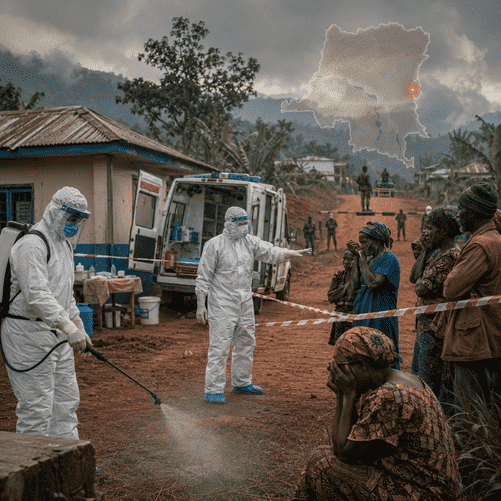
Health officials warn that insecurity, community mistrust and limited access could complicate containment as the outbreak moves beyond its original epicentre

A confirmed Ebola case has been reported in a rebel-held area of eastern Democratic Republic of Congo, raising concern that the outbreak may be spreading into zones where health authorities and aid workers face serious access challenges.
The case was confirmed in South Kivu province, hundreds of kilometres from the outbreak’s original epicentre in Ituri province, according to Reuters. The patient, a 28-year-old, died and was safely buried, but the location of the infection has heightened alarm because the area is controlled by a rebel alliance, making surveillance, contact tracing and medical response far more difficult.
The outbreak has already produced 61 confirmed cases among hundreds of suspected infections, with the Congolese health ministry reporting 160 suspected deaths. The World Health Organization has declared the situation a public health emergency, while neighbouring Uganda has also reported confirmed cases and temporarily suspended flights to the DRC.
The virus involved is the Bundibugyo strain, a form of Ebola for which no approved vaccine is currently available. That makes rapid isolation, community cooperation and protective medical response especially important. But in eastern Congo, those measures are difficult to implement because of armed conflict, displacement and distrust toward authorities.
Containment efforts have already faced disruption. In Ituri’s Rwampara area, protesters reportedly attacked a hospital after disputing an Ebola-related death, underlining the dangerous role that misinformation and mistrust can play during outbreaks. Aid workers have also warned of shortages in essential supplies, partly linked to reductions in foreign aid.
The crisis is now affecting international diplomacy and sport. India and the African Union agreed to postpone the India-Africa Forum Summit in New Delhi because of the “emerging public health situation,” while DR Congo’s national football team cancelled World Cup preparation events in Kinshasa and moved its buildup to Belgium.
For Congo, the new case in South Kivu is a serious warning sign. If infections spread further into conflict zones, the outbreak could become harder to measure and harder to contain. Public health teams need access not only to clinics, but also to communities where fear, insecurity and rumours may prevent people from reporting symptoms.
The coming days will be critical. If authorities can trace contacts quickly and rebuild trust in affected communities, the outbreak may still be contained. But if violence and access restrictions continue, health experts fear the official figures may represent only part of a wider crisis.