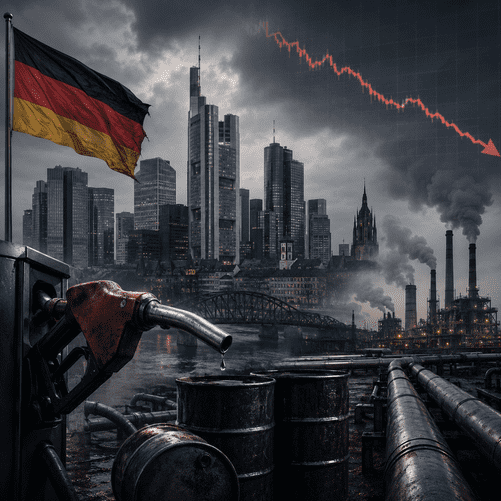
Bundesbank warns growth may flatline in the second quarter as the Iran war lifts fuel costs and weakens business confidence

Germany’s economy is facing a renewed slowdown as rising energy costs linked to the Iran war threaten to choke off an already fragile recovery, the Bundesbank warned on Thursday.
In its latest assessment, Germany’s central bank said economic growth is likely to remain flat in the second quarter of 2026, while inflation is again trending upward. The pressure is coming largely from higher fuel expenses and renewed uncertainty across European markets, as conflict in the Middle East disrupts energy flows and raises fears of another price shock.
The warning lands at a difficult moment for Europe’s largest economy. Germany has spent the past several years struggling with weak industrial demand, high production costs, and uneven export performance. Now, the return of energy-driven inflation risks hitting both companies and households at the same time.
For manufacturers, higher fuel and power costs increase pressure on margins, especially in energy-intensive sectors such as chemicals, metals, logistics, and automotive supply chains. For consumers, more expensive petrol, heating, and transport can quickly reduce disposable income, limiting spending in shops, restaurants, and services.
The problem is not limited to Germany. The European Commission also lowered its eurozone outlook on Thursday, forecasting growth of just 0.9% in 2026, down from its previous estimate of 1.2%, while inflation is now expected to rise to 3.0%, well above the European Central Bank’s 2% target.
That combination places policymakers in a difficult position. If inflation keeps rising, the ECB may feel pressure to tighten monetary policy. But higher interest rates would make loans more expensive for households and companies, potentially deepening the slowdown.
Recent business surveys also suggest that the eurozone economy is losing momentum. Private-sector activity reportedly contracted in May at the fastest pace in more than two years, with demand weakening and companies cutting jobs as cost pressures returned.
Germany’s situation is especially important because of its role as Europe’s industrial engine. A prolonged period of stagnation in Germany would weaken supply chains across Central and Eastern Europe, reduce demand for imports from Asian manufacturers, and complicate the broader eurozone recovery.
Still, the current crisis is not identical to the 2022 energy shock. Europe has diversified energy supplies, expanded storage, and invested more heavily in renewables. But the latest Bundesbank warning shows that the continent remains vulnerable when geopolitical conflict pushes energy prices higher.
For Berlin and Brussels, the message is clear: the economic recovery remains fragile, and energy security has once again become one of Europe’s central economic risks.