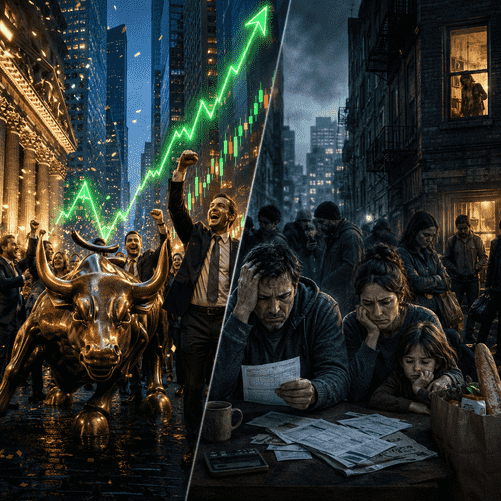
U.S. stocks are climbing to historic highs, but consumer sentiment has fallen to levels not seen in decades, exposing a widening gap between financial markets and everyday economic anxiety.

The American stock market is celebrating. Households are not.
In a striking contradiction, Wall Street is moving through one of its strongest periods in years while U.S. consumers report some of the darkest economic moods in generations. The S&P 500 has extended a powerful rally, the Dow Jones Industrial Average has reached record territory, and investors are once again comparing the market’s momentum to the late-1990s technology boom. Yet beneath the surface, Americans are unusually pessimistic about the economy. According to the University of Michigan consumer sentiment index, public confidence has fallen to its lowest level in more than 70 years.
The contrast is unusual because markets and consumer confidence often move together. In 1999, when technology stocks were surging, optimism was widespread. Investors believed the internet would transform productivity, businesses were expanding, and households felt the benefits of a long economic expansion. Today, the stock market is again being driven by technology enthusiasm, especially artificial intelligence, but the public mood is far more fragile.
Several forces explain the disconnect. Investors are focused on corporate profits, future productivity gains and the possibility that artificial intelligence will reshape entire industries. Large technology companies have become the main engine of market gains, attracting capital from investors who see AI as the next great economic revolution. For Wall Street, the future looks profitable.
For many Americans, however, the present feels expensive and uncertain. High prices, pressure in the labor market and geopolitical instability have damaged confidence. The recent war with Iran has added another layer of anxiety, reinforcing fears about energy costs, inflation and global security. Even as portfolios rise, many households remain focused on grocery bills, housing costs, job stability and wages that may not feel strong enough to keep pace with everyday expenses.
The market’s valuation is also raising concerns. The S&P 500’s Shiller price-to-earnings ratio has moved above 40, a level previously associated with the dot-com bubble era. That does not automatically mean a crash is coming, but it does suggest investors are paying very high prices for future earnings. When expectations become this elevated, markets can become vulnerable to disappointment.
The central question is whether investors are seeing an economic recovery before the public feels it — or whether the market has become detached from reality. One interpretation is optimistic: stocks may be anticipating lower inflation, stronger productivity and a new AI-driven cycle of growth. Another is more troubling: markets may be pricing in a future that is too perfect, while ordinary Americans are already experiencing the weaknesses that investors prefer to ignore.
Artificial intelligence sits at the center of both narratives. It is helping lift the companies that dominate stock indexes, but it is also creating uncertainty for workers who fear automation, restructuring and job displacement. The same technology that excites investors may be one reason consumers feel less secure about the future.
This is what makes the current moment so unusual. Wall Street is not simply rising while Main Street struggles; it is rising partly because investors believe the economy is changing in ways that many workers find threatening. The stock market is betting on transformation. The public is bracing for disruption.
For now, the party continues. But history suggests that when markets and households tell radically different stories, one of them is eventually forced to adjust. Whether that means consumer confidence recovers or stock prices fall back to earth may define the next phase of the American economy.