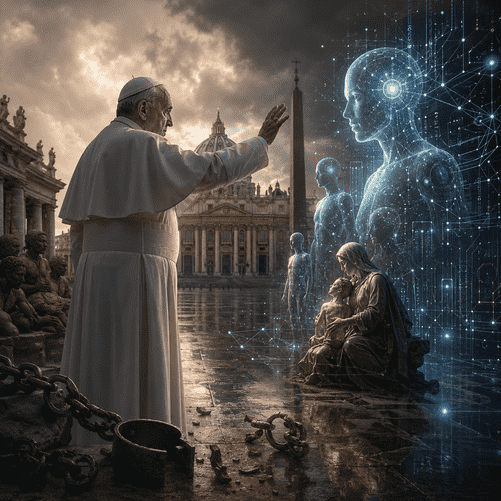
In his first major encyclical, the pontiff calls for the “disarming” of artificial intelligence, tighter global regulation and a moral reckoning over the Church’s delayed condemnation of slavery.

Pope Leo XIV has issued one of the Vatican’s strongest warnings yet on artificial intelligence, denouncing what he called a global “culture of power” behind the race to develop increasingly advanced systems and urging governments, companies and citizens to ensure that technology remains subordinate to human dignity.
In his first encyclical, Magnifica Humanitas, the Pope argued that AI is not merely a technical innovation, but a civilisational test. He warned that artificial intelligence is already reshaping war, labour, politics, education and the distribution of power, while too much control remains concentrated in the hands of a small number of private technology companies and governments.
The pontiff’s most forceful language focused on warfare. He said it was not morally acceptable to entrust lethal or irreversible decisions to artificial systems, warning that autonomous weapons risk removing human judgment from questions of life and death. His call for the “disarming” of AI was not a rejection of technology itself, but a demand that it be prevented from becoming an instrument of domination, exclusion or death.
The document places Leo firmly in the tradition of Catholic social teaching, echoing the legacy of Pope Leo XIII’s Rerum Novarum, which addressed the upheavals of the Industrial Revolution. This time, the new industrial revolution is digital: algorithms, data, machine learning and automated decision-making systems that can influence jobs, credit, healthcare, public services and even democratic debate.
Leo also criticised the economic model surrounding AI, arguing that technological progress cannot be justified if it systematically sacrifices workers or deepens inequality. He warned that the digital economy relies not only on elite engineers and investors, but also on invisible labour: data labellers, content moderators, low-paid platform workers and those involved in extracting minerals needed for the global technology supply chain.
In one of the encyclical’s most historically significant passages, the Pope apologised for the Catholic Church’s delayed condemnation of slavery. He described slavery as a wound in Christian memory and acknowledged that the Church took far too long to recognise its full incompatibility with human dignity. The apology was linked to his broader warning that new forms of exploitation are emerging in the digital age.
The Vatican’s decision to present the document at an event attended by AI specialists underlined the Church’s intention to participate directly in the global debate over artificial intelligence. Among those present was Christopher Olah, a co-founder of Anthropic, reflecting the Vatican’s effort to engage not only theologians and policymakers, but also the people building the technology itself.
The encyclical arrives at a moment of mounting concern over AI’s impact on misinformation, military systems, labour markets and democratic institutions. Leo warned that algorithms can amplify polarisation and conflict, weakening public trust and making societies more vulnerable to manipulation. In his view, the AI race is not only about innovation, but about who controls knowledge, power and the future of human relationships.
His message is likely to resonate far beyond the Catholic Church’s 1.4 billion members. By framing AI as a moral and political challenge rather than a purely technological one, Pope Leo has positioned the Vatican as a voice in the debate over how artificial intelligence should be governed.
The central question raised by Magnifica Humanitas is direct: whether humanity will use AI as a tool for the common good, or whether it will allow the technology to become another mechanism of inequality, surveillance and war. For Leo, the answer depends not on machines, but on the ethical choices of the people who design, finance, regulate and deploy them.