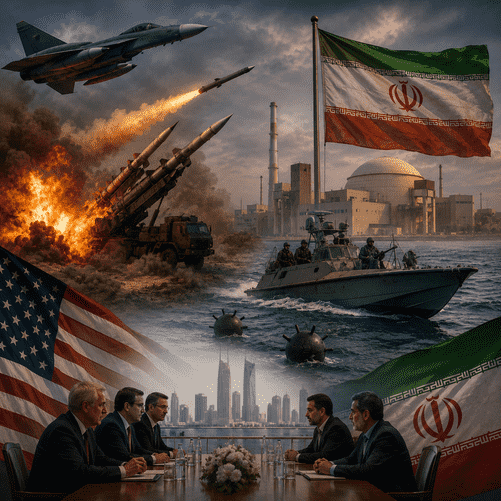
Fresh American attacks on missile positions and mine-laying vessels underline the fragility of diplomacy, even as Iranian negotiators travel to Qatar to discuss Tehran’s nuclear programme and frozen assets.

The United States has carried out new strikes against Iranian military targets, hitting missile launch sites and vessels allegedly involved in mine-laying operations, as President Donald Trump’s promised peace deal with Tehran remains uncertain.
U.S. Central Command described the strikes in southern Iran as defensive actions aimed at protecting American forces from Iranian threats. According to U.S. officials, the targets included missile positions and boats suspected of laying mines near sensitive maritime routes, a development that could threaten commercial shipping and energy flows through the Gulf.
The operation came at a delicate moment for diplomacy. Iranian negotiators travelled to Qatar on Monday for talks that reportedly involve the future of Iran’s nuclear programme and access to frozen Iranian assets held abroad. The presence of Iran’s central bank governor in the delegation has fuelled expectations that financial relief is a central part of the negotiations.
For Washington, the challenge is to maintain military pressure while keeping negotiations alive. Trump has repeatedly suggested that a deal with Iran could be close, but the latest strikes show how easily the process can be disrupted by events on the ground. U.S. Secretary of State Marco Rubio has said Washington still hopes for progress, while warning that the United States would seek other options if talks fail.
At the center of the dispute is Iran’s nuclear programme. Western governments want limits on enrichment, stronger monitoring and guarantees that Tehran cannot move toward a nuclear weapon. Iran, meanwhile, is seeking sanctions relief, access to frozen funds and a broader easing of economic pressure. Reports suggest one possible framework could involve Iran taking steps on enriched uranium under international supervision, while wider nuclear concessions would be addressed in later negotiations.
The talks are also linked to the Strait of Hormuz, one of the world’s most important energy chokepoints. Any mining activity or military escalation in the area could disrupt oil and gas shipments, raising global energy prices and increasing pressure on already nervous markets. That is why the alleged mine-laying vessels targeted by the U.S. carry significance beyond the immediate military confrontation.
Qatar has emerged as a key mediator because of its role in regional diplomacy and its connection to frozen Iranian funds. For Tehran, access to those assets could provide badly needed economic relief. For Washington, financial concessions may be used as leverage to extract nuclear and security guarantees.
Still, the gap between military reality and diplomatic ambition remains wide. The U.S. says its strikes are limited and defensive, but Iran is likely to view them as pressure tactics carried out while negotiations are underway. That creates a risk that either side could harden its position, delaying a deal or making one politically harder to sell at home.
Trump’s strategy appears to rely on a mix of coercion and negotiation: strike when U.S. forces are threatened, but keep the door open to an agreement that could reshape the regional balance. Yet the same approach also exposes the weakness of the current process. A peace deal may be discussed in Doha, but it is being tested in real time across the Gulf.
For now, the negotiations remain alive, but fragile. The question is whether the Qatar talks can produce a credible path toward de-escalation — or whether new strikes, maritime threats and unresolved nuclear demands will keep the U.S. and Iran trapped between diplomacy and confrontation.