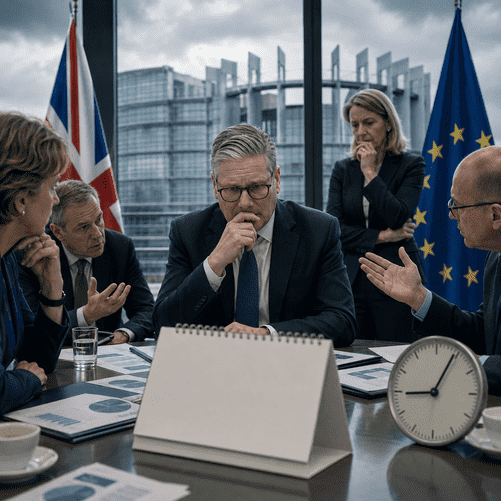
The absence of a confirmed date for the next UK-EU leaders’ meeting is becoming a political problem for Downing Street, exposing the fragility of Labour’s post-Brexit strategy.

Keir Starmer’s attempt to rebuild Britain’s relationship with the European Union is facing another awkward test: the summit that was meant to demonstrate momentum in the “reset” still has no publicly confirmed date.
For a government that has made calmer, more pragmatic relations with Brussels a central part of its foreign and economic policy, the uncertainty is more than a scheduling detail. It has begun to raise questions in London and Brussels about how much progress the reset has really made — and whether both sides are now struggling to agree on the next stage.
The UK and EU held their first formal post-Brexit summit in London on 19 May 2025, where Starmer and EU leaders presented a new partnership as a break from years of strained relations after Brexit. At the time, Downing Street described the agreement as a “landmark deal” and a “new stage” in relations between Britain and the bloc.
But one year later, the choreography looks less confident. Analysts at the Centre for European Reform noted earlier this year that the two sides had agreed to hold annual summits, with expectations that the next one would take place in May 2026, after the UK local elections — yet no exact date had been agreed.
That absence matters because summits are political signals. A confirmed date would suggest that both sides are ready to move forward. A delay, by contrast, risks feeding the impression that negotiations have become more complicated behind the scenes.
The core problem is that Starmer’s reset must satisfy two very different audiences. In Brussels, officials want clarity, legal certainty and a clear UK willingness to accept obligations in exchange for access. In Westminster, Starmer must avoid appearing to reopen Brexit or surrender too much ground to the EU.
That tension has become sharper after reports that Britain floated the idea of a single market for goods with the EU. Reuters reported that the UK proposal was aimed at reducing post-Brexit trade friction, but that the EU pushed back, warning that deeper access would require deeper obligations — including forms of alignment that remain politically difficult for Labour.
The Financial Times also reported that the EU rejected the UK’s push for a goods-focused single market arrangement, with Brussels preferring to stick to areas already included in the reset agenda, such as defence, migration, veterinary standards, emissions trading and youth mobility.
For Starmer, this creates a familiar post-Brexit dilemma. The UK wants smoother trade with its largest nearby market, but the EU remains unwilling to offer the benefits of membership-style access without membership-style commitments. That imbalance has defined much of the Brexit debate since 2016, and Labour has not escaped it.
The politics at home are equally uncomfortable. Starmer has repeatedly ruled out rejoining the EU, the single market or the customs union, while promising to make Brexit work better. But pressure is growing from pro-European voices who argue that limited technical fixes will not be enough to boost growth or repair Britain’s economic position.
Former foreign secretary David Miliband recently argued that the UK needs a broader “national consensus” on its future relationship with Europe, saying the current reset does not go far enough. His intervention reflects a wider concern among Labour and liberal internationalist circles that Starmer is moving too cautiously.
At the same time, any move that looks too close to EU reintegration risks giving ammunition to Conservative and Reform UK critics, who accuse Labour of trying to reverse Brexit by stealth. That leaves Downing Street caught between economic logic and political caution.
The delay in confirming a summit date therefore lands at a sensitive moment. It suggests that the reset is no longer simply about better tone and diplomatic repair. It is now entering the harder phase: deciding what Britain is prepared to trade for better access, and what the EU is willing to offer without undermining its own internal rules.
There has been some movement. A UK parliamentary report published in March 2026 said ministers had made progress since the May 2025 summit, including work on a Strategic Partnership, security and defence cooperation, and steps to explore reducing trade friction. It also noted UK participation in Erasmus+ from 2027 under a temporary discounted arrangement.
Security cooperation remains one of the easier areas. On 26 May 2026, the UK government announced a major defence and security treaty with Poland, presenting it as part of Starmer’s broader effort to deepen cooperation with European partners.
But trade, mobility and regulatory alignment are much more politically sensitive. These are the issues that determine whether the reset produces economic substance or remains mostly diplomatic symbolism.
The risk for Starmer is that expectations are now running ahead of delivery. If the summit is delayed, downgraded or produces only limited results, critics will argue that the reset has stalled. If it produces a deeper agreement, opponents may claim Labour is crossing its own red lines.
For Brussels, the calculation is also delicate. The EU wants a stable relationship with the UK, especially on defence and security, but it has little interest in creating a special arrangement that allows Britain to regain market advantages without accepting the rules that come with them.
That is why the missing summit date has become politically significant. It captures the central weakness of Starmer’s EU strategy: the promise of a reset is popular in theory, but difficult in practice. Better relations are possible. A fundamentally new economic settlement is much harder.
For now, the delay does not mean the reset has failed. But it does show that the easy phase is over. Starmer can no longer rely on warm language, symbolic meetings and a change of tone. The next summit, whenever it happens, will have to prove that the UK-EU reset is more than a diplomatic slogan.