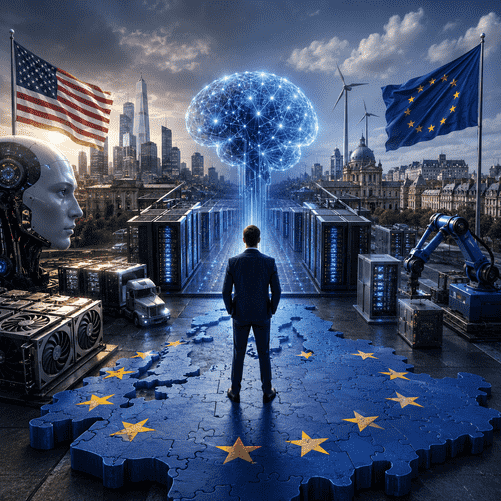
The French company’s CEO says Europe’s fight for technological independence will depend less on ambition than on the scale of investment needed to build sovereign AI infrastructure.

Europe’s leading artificial intelligence champion is warning that the continent could become dangerously dependent on American technology unless it finds the money, infrastructure and political will to compete at scale.
Mistral AI, the Paris-based startup often described as France’s answer to OpenAI, has become a symbol of Europe’s attempt to build its own place in the global AI race. But its chief executive, Arthur Mensch, says the biggest obstacle to European technological independence is no longer talent or ideas. It is the enormous cost of building the computing power, data centers and energy systems required to train and deploy frontier AI models.
The warning comes as artificial intelligence becomes not only a commercial technology, but also a strategic asset. Control over AI models, cloud infrastructure and advanced chips increasingly shapes national security, industrial competitiveness and scientific research. For Europe, the concern is that dependence on U.S. cloud providers and AI platforms could leave governments, companies and citizens reliant on foreign systems for critical digital services.
Mistral’s message is direct: Europe cannot claim digital sovereignty while outsourcing the foundations of the AI economy. The company has positioned itself as a European alternative to U.S. giants such as OpenAI, Google, Microsoft and Amazon, offering AI models and services designed to be hosted within European infrastructure and adapted to European regulatory and business needs.
Yet the challenge is immense. American technology companies are spending hundreds of billions of dollars on AI data centers, chips and cloud capacity. Europe, by contrast, remains fragmented across national markets, slower capital channels and more cautious public investment. Even successful startups face a difficult path when trying to scale at the speed of Silicon Valley.
Mistral has moved aggressively to close part of that gap. The company has raised major funding, signed deals with large European industrial groups and announced plans to expand AI computing infrastructure in France and Sweden. Its partnerships with companies such as Airbus and BMW show that European industry is looking for alternatives to U.S.-controlled AI systems, particularly in sectors linked to defense, manufacturing and strategic technology.
But Mensch’s warning reflects a broader anxiety across Europe: the AI race may be decided by infrastructure before regulation, ethics or even model quality. The companies that control chips, data centers and cloud distribution could define the rules of the next digital economy. Without comparable investment, Europe risks becoming a customer of AI rather than a producer of it.
The issue is also political. European leaders have spoken for years about “technological sovereignty,” especially after crises involving energy dependence, supply chains and digital security. AI has now become the latest and perhaps most consequential test of that ambition. If Europe fails to build its own AI capacity, its companies may remain dependent on U.S. platforms for everything from enterprise software to defense systems.
Mistral’s stance is not without controversy. The company has defended the use of AI in military applications, arguing that Europe cannot remain strategically dependent on others while rival powers develop similar capabilities. That position has drawn criticism from those who fear the militarization of artificial intelligence, but Mistral insists that sovereignty includes the ability to defend European interests with European-built tools.
The debate now confronting Europe is whether it is willing to match its strategic language with strategic spending. Regulations alone will not produce an AI superpower. Nor will isolated national projects be enough to rival the scale of American and Chinese investment.
Mistral’s rise has proved that Europe can still produce world-class AI companies. The harder question is whether it can build the industrial and financial ecosystem needed to keep them independent.
For Europe, the warning is clear: the future of artificial intelligence may not be decided only by who writes the best algorithms, but by who owns the infrastructure beneath them.