Jeff Bezos’ space company says all personnel are safe after a fiery test failure at Cape Canaveral

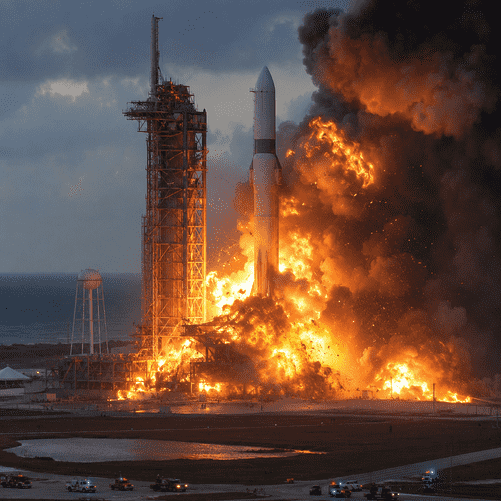
Blue Origin suffered a major setback after one of its New Glenn rockets exploded on the launchpad during preparations for an upcoming mission, sending a huge fireball into the night sky at Cape Canaveral.
The incident occurred during a hot-fire test, a procedure in which a rocket’s engines are ignited while the vehicle remains secured to the ground. Such tests are designed to validate engine performance and launch readiness before flight. Instead, the test ended in a dramatic explosion that destroyed the rocket and damaged launch infrastructure.
The company, founded by Jeff Bezos, said all personnel were accounted for and safe. No injuries were reported, and emergency teams responded to the scene. Bezos later described the incident as a difficult day for the company, saying it was too early to determine the root cause but that teams were already working to understand what happened.
The rocket involved was New Glenn, Blue Origin’s heavy-lift launch vehicle and the centerpiece of its ambition to compete more directly with SpaceX in the commercial launch market. The vehicle was being prepared for a coming mission, making the explosion a serious blow to Blue Origin’s schedule at a time when the company is trying to accelerate operations and prove the reliability of its flagship rocket.
The blast is expected to trigger a detailed investigation involving Blue Origin, launch-site authorities and federal regulators. Engineers will examine telemetry, engine data, ground-system performance and video evidence to determine whether the failure originated in the rocket, the pad infrastructure or the fueling and test sequence.
For Blue Origin, the timing is especially difficult. New Glenn is central to the company’s future plans, including commercial satellite launches, Amazon-related space internet deployments and potential NASA missions. Any significant damage to the launchpad could delay future flights, particularly if repairs require months of work.
The explosion also underscores the risks of developing large reusable rockets. Hot-fire tests are routine in the space industry, but they involve enormous amounts of fuel, pressure and energy. Even when safety protocols work and personnel remain protected, a failure can destroy hardware, damage ground systems and disrupt an entire launch campaign.
Blue Origin has spent years developing New Glenn as a reusable heavy-lift rocket capable of carrying large payloads to orbit. The program has been viewed as a key part of Bezos’ broader space strategy, aimed at moving Blue Origin beyond suborbital tourism and into the highly competitive market for orbital launches.
The company now faces two immediate challenges: identifying the cause of the explosion and restoring confidence in New Glenn’s readiness. Customers, regulators and government partners will be watching closely to see how quickly Blue Origin can recover and whether the failure leads to wider delays.
In the space industry, dramatic failures are not uncommon, and companies often frame them as part of the testing process. But the loss of a full rocket on the launchpad is more than a technical setback. It is a costly interruption to one of Blue Origin’s most important programs.
For Bezos’ company, the message is now one of damage control and resilience. No lives were lost, but the explosion has raised urgent questions about New Glenn’s path forward — and about how quickly Blue Origin can return to the launchpad.a