Designed with Jony Ive’s minimalist eye, Ferrari’s first EV is meant to open a new chapter for Maranello. Instead, it has exposed a fierce argument over what a Ferrari should be.

Ferrari wanted the Luce to look like the future. Instead, for many of its most loyal fans, it looked like a betrayal.
The Italian carmaker’s first fully electric vehicle was designed to do something no Ferrari has ever had to do before: defend the brand’s prestige in a world where Chinese electric vehicles are rewriting the rules of speed, technology and luxury. But almost as soon as the Luce was unveiled, the debate shifted from performance to identity.
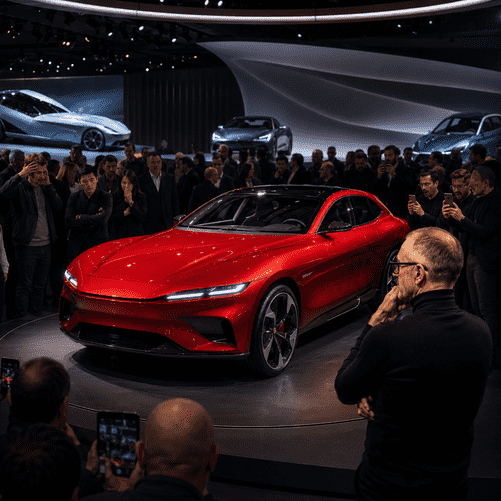
Created with the involvement of Sir Jony Ive, the former Apple design chief behind some of the most influential consumer products of the last quarter-century, the Luce is unlike the low, aggressive, combustion-powered machines that made Ferrari a global symbol of desire. It is electric, minimalist, four-door, five-seat and aimed at a new class of ultra-wealthy buyers who may care as much about design language and software-era luxury as about engine noise.
That is precisely the problem for critics.
For purists, Ferrari is not simply a badge. It is a mythology built around racing, sound, scarcity and the emotional theatre of internal combustion. The Luce challenges that mythology at almost every point. Its design is smoother, quieter and more restrained than the brand’s traditional supercars. Its interior reportedly leans away from giant touchscreens and toward tactile controls, reflecting Ive’s belief that digital minimalism should not overwhelm the act of driving. Yet even that design philosophy has become part of the controversy.
The reaction has been severe. Ferrari shares fell after the launch, with investors questioning whether the company had misjudged the appetite for a high-priced luxury EV at a moment when demand for electric vehicles is uneven across major markets. Online, the car became an instant target for jokes and comparisons to mainstream electric sedans, minivans and tech products rather than to Ferrari icons.
The backlash is not only about styling. It is about fear of dilution.
Ferrari has always walked a narrow line between expansion and exclusivity. Every new model must bring in money without making the brand feel ordinary. The Luce is a particularly risky test of that balance because it moves Ferrari into territory already crowded with fast, advanced electric cars. Chinese manufacturers have become increasingly sophisticated, offering EVs with striking acceleration, high-end digital cabins and competitive pricing. While Ferrari is playing at a very different price level, the psychological challenge is real: in the electric age, raw speed is no longer rare.
That changes the meaning of a Ferrari.
In the combustion era, Ferrari could rely on the emotional difference of its engines, its racing heritage and its sound. In the electric era, acceleration can be delivered by companies with no Formula One mythology at all. The Luce is Ferrari’s attempt to answer that threat by making design, craftsmanship, exclusivity and brand aura matter even more. But the early reaction suggests that many customers and fans are not yet convinced that an electric Ferrari can carry the same emotional weight.
Ferrari insists the Luce is not a replacement for its traditional soul, but an expansion of it. Executives have argued that the company will continue to offer different powertrains and that electrification is only one part of its future. The car’s limited production also reduces the commercial risk: at a price reported around €550,000, Ferrari does not need mass-market acceptance. It needs a small group of buyers wealthy and curious enough to want the most controversial Ferrari in decades.
That group may exist. Ferrari’s leadership has suggested that orders are already coming in, including from new customers. In that sense, the outrage may even help the Luce. Controversy can damage a mass-market car; for a luxury object, it can sometimes increase fascination.
Still, the Luce has revealed a deeper tension facing every legacy performance brand. Electrification is not just a technological shift. It is a cultural one. It forces companies built on noise, fuel and mechanical drama to explain what remains when the engine disappears.
For Ferrari, the answer was supposed to be light, design and reinvention. That is what “Luce” promises. But the fury around the car shows how hard reinvention can be when a brand’s past is not merely remembered, but worshipped.
The Luce may eventually be seen as a bold first step into Ferrari’s electric future. Or it may be remembered as the moment Maranello discovered that even the most powerful badge in motoring cannot escape the identity crisis of the EV age.