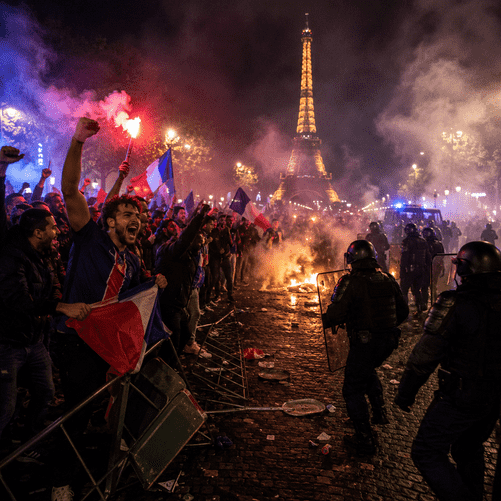
Paris Saint-Germain’s victory over Arsenal brought scenes of jubilation across France, but celebrations were marred by riots, fires and clashes with police in Paris and other cities.

French police arrested more than 400 people after Paris Saint-Germain’s Champions League victory over Arsenal sparked celebrations that quickly descended into violence in parts of Paris and across the country.
The unrest broke out after PSG secured the European title in a dramatic final against Arsenal, a result that sent thousands of supporters into the streets. In the capital, crowds gathered on the Champs-Élysées and around other symbolic locations, waving flags, sounding car horns and lighting flares. But what began as mass celebration was soon overshadowed by clashes between groups of fans and police.
According to French authorities, almost 300 people were detained in Paris alone, while rioting was reported in about 15 cities across France. Seven police officers were injured during the disturbances, and officials said several shops were vandalised, vehicles were set on fire and fireworks were launched during confrontations with security forces.
Interior Minister Laurent Nuñez condemned the violence, calling it “absolutely unacceptable.” He said the incidents did not represent the majority of PSG supporters, many of whom had gathered peacefully to celebrate one of the most important nights in the club’s history.
The scale of the police operation reflected how seriously authorities had prepared for possible disorder. Tens of thousands of officers were deployed across France, with a heavy presence in Paris, where officials had expected huge crowds after the final. Security forces were stationed near the Champs-Élysées, the Parc des Princes and other gathering points in an attempt to prevent a repeat of previous football-related unrest.
Despite the violence, the government said PSG’s official celebrations would proceed. The club’s players were expected to take part in a public event near the Eiffel Tower, followed by a reception with President Emmanuel Macron at the Élysée Palace. The decision underlined the political and cultural importance of PSG’s triumph, even as officials faced questions over crowd control and urban disorder.
For PSG, the victory marked another historic step in the club’s transformation from domestic powerhouse to European giant. Backed by years of heavy investment and global ambition, the Parisian side has become one of football’s most high-profile projects. Winning the Champions League has long been the ultimate objective for the club’s owners, players and supporters.
But the scenes after the final revealed the darker side of mass football celebrations in France. Paris has repeatedly struggled to manage the emotional force of major sporting nights, especially when large crowds gather in areas already associated with protest, tourism and nightlife. Celebrations can quickly become a mixture of genuine joy, opportunistic vandalism and confrontation with police.
The latest unrest also risks feeding a broader political debate about public order. In France, football violence is not only a sporting issue. It intersects with questions of policing, urban security, youth unrest and the state’s ability to manage large spontaneous gatherings. Opposition politicians are likely to use the arrests as evidence that authorities remain unable to prevent predictable disorder, while officials will argue that the security deployment helped contain a much larger threat.
For most PSG fans, however, the night was about history. The club’s supporters filled the streets with colour and noise, celebrating a victory that many had waited decades to see. Yet the images likely to dominate the aftermath will not only be of flags and fireworks, but of burning vehicles, riot police and mass arrests.
PSG’s Champions League win was supposed to unite Paris in celebration. Instead, it left France balancing pride in a landmark sporting achievement with anger over the violence that followed.