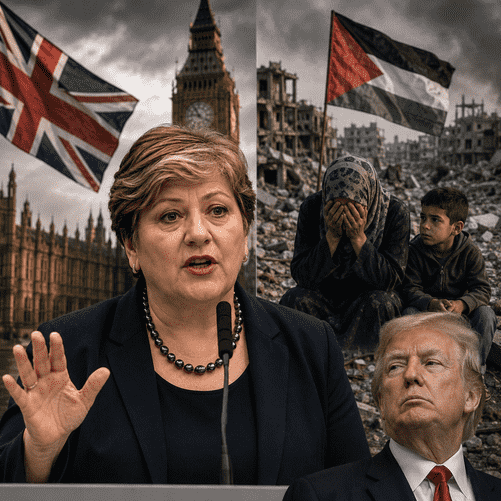
Emily Thornberry accused Israel of acting with a “staggering” sense of impunity and criticised Donald Trump for abandoning Gaza after prematurely claiming progress toward peace.

A senior Labour MP has accused the UK government of failing the Palestinian people, delivering one of the strongest internal criticisms yet of Britain’s handling of the war in Gaza and the wider Israeli-Palestinian crisis.
Emily Thornberry, who chairs the House of Commons foreign affairs select committee, said the government had not done enough after recognising Palestine as a state and had failed to turn that symbolic step into meaningful diplomatic pressure. Her remarks point to growing frustration within Labour over whether the UK has matched its rhetoric on Palestinian statehood with practical action.
Thornberry’s criticism comes at a moment of deepening alarm over Gaza, where humanitarian conditions remain dire despite repeated international calls for ceasefire, aid access and a political settlement. She argued that Britain’s response had fallen short not only morally, but diplomatically, allowing the crisis to worsen while Israel continued to act without sufficient consequences.
At the centre of her intervention was a sharp condemnation of Israel’s conduct. Thornberry described what she saw as a “staggering” sense of impunity from the Israeli government, particularly in relation to Gaza and the occupied West Bank. She warned that plans for further control or annexation of Palestinian territory would make a viable two-state solution even harder to achieve.
Her comments also targeted Donald Trump, whom she accused of abandoning Gaza after declaring progress toward peace too early. Thornberry suggested that the former US president’s approach had helped create a false sense of resolution while Palestinians continued to suffer and the political process remained fragile.
The intervention is significant because Thornberry is not speaking from the party’s left fringe, but from a senior parliamentary position focused on foreign affairs. Her criticism reflects a wider unease among Labour MPs, human rights advocates and international lawyers who argue that Britain must move beyond statements of concern and adopt stronger measures.
Among the actions being urged are sanctions against individuals linked to illegal settlement expansion, restrictions on trade with settlements, and clearer limits on British business involvement in activities connected to occupation. Thornberry also called for the UK to respond more seriously to international legal findings and to use its diplomatic weight to press for accountability.
The government has repeatedly said it supports a two-state solution and wants to see long-term peace between Israelis and Palestinians. But critics say that position has become increasingly hollow without enforcement mechanisms or consequences for actions that undermine Palestinian statehood.
For Prime Minister Keir Starmer, the issue remains politically delicate. Labour has faced sustained pressure from voters, activists and MPs over Gaza, with many accusing the government of being too cautious in confronting Israel. At the same time, ministers have sought to balance support for Palestinian rights with concern for Israel’s security and the release of hostages.
Thornberry’s remarks therefore expose a central tension in British foreign policy: whether recognition of Palestine can be treated as an endpoint, or whether it must be followed by sanctions, legal pressure and a broader diplomatic campaign.
The debate also reflects Britain’s diminished but still important role in Middle East diplomacy. As a permanent member of the UN Security Council and a country with historical responsibility in the region, the UK faces calls to act not merely as a commentator, but as a power capable of shaping international pressure.
For Palestinians, Thornberry argued, the question is no longer whether world leaders express sympathy. It is whether they are willing to act when occupation, bombardment, displacement and hunger continue despite years of warnings.
Her intervention will add pressure on the government to clarify what comes next. Recognition of Palestine may have marked a diplomatic shift, but Thornberry’s message was blunt: without real consequences for those blocking peace, Britain’s policy risks becoming another declaration that changes little on the ground.