The explosion, believed to have been caused by mining explosives stored in a warehouse, has left a border community in ruins and renewed scrutiny over the dangers of conflict-linked resource extraction.

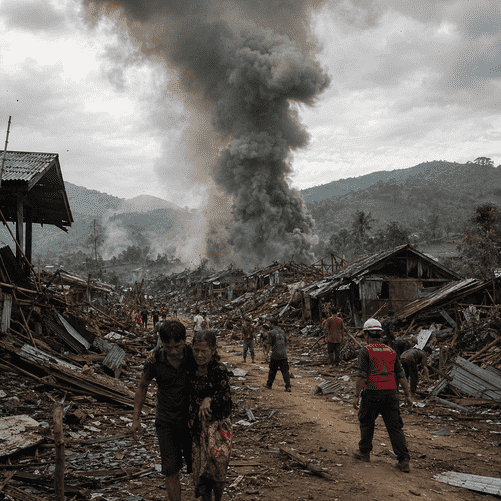
A powerful explosion has killed dozens of people and injured many more in a rebel-held village in northeastern Myanmar, flattening homes and leaving rescue workers searching through debris in one of the deadliest disasters to hit the region this year.
The blast struck Kaungtup village in Namhkam Township, Shan State, close to Myanmar’s border with China. Local reports and rescue workers said more than 45 people were killed, while some accounts placed the toll at at least 55. Around 70 others were reported injured, with the final number of casualties still uncertain as emergency teams continued recovery work.
The area is controlled by the Ta’ang National Liberation Army, or TNLA, an ethnic armed group that has fought Myanmar’s military junta and holds territory in parts of northern Shan State. According to the group, explosives used for mining and quarrying had been stored in the area, and an investigation is underway into what caused them to detonate.
Witnesses described a devastating scene. The explosion sent a huge cloud of smoke into the sky, damaged or destroyed scores of homes and left parts of the village reduced to rubble. Residents initially feared the blast may have been an airstrike, a common threat in Myanmar’s civil war, but early reports pointed instead to an accidental detonation of stored explosive material.
The tragedy highlights the extreme vulnerability of civilians living in territory controlled by armed groups, where conflict, weak regulation and informal economic activity often overlap. Mining is a major source of revenue in parts of Myanmar, particularly in areas rich in minerals, gemstones and other natural resources. But the storage and handling of explosives in unstable conflict zones can carry deadly risks.
Myanmar has been engulfed in violence since the military seized power in a 2021 coup, triggering nationwide resistance and a widening civil war. Ethnic armed organisations and pro-democracy forces have gained ground in several regions, while the junta has relied heavily on airstrikes, artillery and military offensives to try to regain control.
Northern Shan State has been among the most strategically important and contested areas of the conflict. Its proximity to China, its trade routes and its mineral resources have made it a key battlefield for armed groups, the military and local power networks. For civilians, that has meant repeated displacement, disrupted livelihoods and exposure to both military violence and industrial hazards.
The TNLA has said it will support affected residents with aid, medical treatment and rehabilitation. But for survivors, the immediate priority remains finding missing relatives, treating the wounded and recovering what is left of a shattered community.
The explosion is not only a local disaster. It is a stark reminder of how Myanmar’s war has transformed ordinary villages into zones of layered danger, where military conflict, economic survival and unsafe infrastructure can combine with catastrophic consequences.