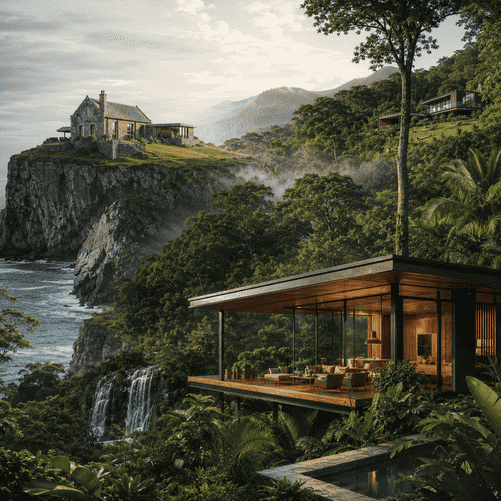
From rainforest hideaways in Costa Rica to cliff-top stone retreats in Scotland, a new generation of seasonal homes is redefining luxury through silence, restraint and respect for nature.

The most desirable summer homes are no longer defined only by infinity pools, polished interiors or postcard views. Increasingly, they are judged by a quieter standard: how well they belong to the landscape around them.
Across forests, islands, deserts, coastlines and mountain ridges, architects are designing retreats that do not simply sit in nature, but appear to grow from it. These are homes shaped by terrain, climate, light and local materials. They blur the line between shelter and scenery, offering escape without isolation and luxury without excess.
One of the strongest examples comes from Costa Rica, where tropical architecture has become a laboratory for living lightly in dense rainforest. Homes embedded in the jungle often rely on open-air layouts, shaded terraces and deep overhangs rather than sealed, air-conditioned interiors. Concrete, timber, steel and glass are used not to dominate the forest, but to frame it. In the best projects, the house becomes a viewing instrument: a place from which to hear rain, watch leaves move and experience the slow rhythm of the canopy.
The appeal is not only visual. In warm climates, architecture that works with nature can also perform better. Cross-ventilation reduces the need for mechanical cooling. Raised platforms protect fragile ground conditions. Large openings allow interiors to expand outward, while natural materials soften the boundary between domestic space and wilderness.
In Scotland, the relationship between home and landscape takes a different form. Here, the drama comes from wind, stone, sea and exposed cliffs. A cliff-top summer retreat in the Scottish wilds does not need tropical openness; it needs endurance. Thick walls, low profiles and rugged materials allow a house to withstand harsh weather while still offering intimacy and warmth. Rather than hiding from the elements, these homes invite residents to observe them from a place of protection.
That contrast — the rainforest house and the stone retreat — captures the broader movement in contemporary summer-home design. Harmony with nature does not mean copying one aesthetic. It means responding honestly to place.
In coastal regions, that might mean weathered timber, retractable walls and terraces angled toward sea breezes. In mountain landscapes, it might mean pitched roofs, stone bases and interiors built around fireplaces and panoramic windows. In dry climates, it may involve courtyards, shaded passages and thick thermal walls that keep interiors cool. In forest settings, architects often reduce footprints, lift structures above roots and use dark finishes that recede into the trees.
What unites these homes is restraint. They do not compete with the setting. Instead, they make the setting the main event.
This is a shift from the traditional idea of the summer house as a status symbol. For decades, seasonal retreats often announced themselves through size, spectacle and visibility. Today’s most compelling examples are more discreet. They are designed to be discovered slowly: a roofline hidden in grass, a glass wall reflecting woodland, a terrace cut into rock, a path that bends before revealing the entrance.
The interiors follow the same philosophy. Natural stone, linen, raw timber, clay, limewash and handmade tiles replace highly polished surfaces. Rooms are designed for barefoot living, open windows and long meals that drift from kitchen to terrace. The best spaces feel less decorated than composed — simple enough to let the surroundings carry the emotion.
Sustainability is also central to the appeal, although the term is often overused. A truly nature-led home is not sustainable simply because it has a beautiful view. It must consider energy use, materials, water, construction impact and long-term resilience. Some retreats use solar power, rainwater collection or passive cooling. Others focus on local craftsmanship and low-impact building methods. The most convincing projects combine beauty with responsibility.
There is also a psychological reason these homes resonate. After years of urban intensity, digital overload and climate anxiety, many people are looking for spaces that restore attention. A summer retreat in harmony with nature offers more than escape. It offers recalibration. It asks residents to wake with daylight, move with weather and measure time by tides, shadows or birdsong.
That does not mean rough living. Many of these homes are deeply comfortable. The luxury lies in precision: a perfectly framed view, a bath facing the forest, a bedroom open to night air, a dining table placed where sunset arrives at exactly the right angle. It is a kind of luxury that depends less on accumulation and more on atmosphere.
The 10 most striking summer homes immersed in nature show how architecture can become a mediator between human comfort and wild surroundings. Whether perched above a Scottish cliff, folded into a Costa Rican rainforest, tucked beside a lake or buried into a hillside, each retreat asks the same question: how little does a house need to do in order to make nature feel even more powerful?
The answer is often simple. It must listen first, then build.