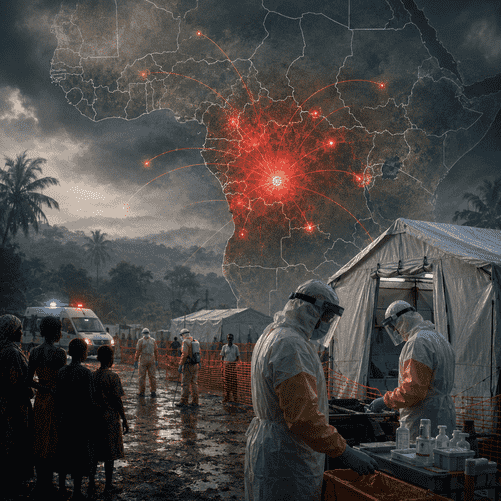
CDC modelling suggests the epidemic may be on a dangerous trajectory, but experts caution that outbreak forecasts remain highly uncertain.

A fast-growing Ebola outbreak in central Africa could approach the scale of the devastating 2014-2016 West Africa epidemic unless urgent public health measures are strengthened, according to new modelling released by the US Centers for Disease Control and Prevention.
The CDC’s analysis warns that the outbreak, driven by the Bundibugyo strain of Ebola, could reach 20,000 cases or more without effective containment. In the worst scenarios, officials say the epidemic could move toward the scale of the 2014-2016 outbreak in Guinea, Liberia and Sierra Leone, which remains the largest Ebola crisis ever recorded, with more than 28,000 reported cases and over 11,000 deaths.
The current outbreak has been concentrated in the Democratic Republic of the Congo, with cases also reported in Uganda. Recent figures cited by international agencies show several hundred confirmed infections and dozens of deaths, though experts warn the real toll may be higher because of delayed testing, insecurity and underreporting in affected areas.
US officials say the key factor now is speed. Ebola spreads through direct contact with the bodily fluids of infected people or those who have died from the disease, making rapid isolation, contact tracing, safe burials and community trust essential to stopping transmission. CDC modelling suggests that if only a small share of patients are isolated quickly after symptoms begin, case numbers could rise sharply. But if isolation rates improve substantially, the outbreak could be kept far smaller.
The warning has triggered renewed calls for international action. The World Health Organization has launched a $518 million six-month response plan aimed at containing the outbreak in Congo and Uganda while strengthening preparedness in neighbouring countries. The plan includes expanded surveillance, border screening, laboratory capacity, treatment centres and community engagement.
The United States has also announced additional support, including almost $38 million in new Ebola response funding, bringing its total commitment to more than $200 million. US officials say the money is intended to support containment efforts close to the source, while CDC teams assist with technical response work in the region.
The outbreak is especially difficult because it involves the Bundibugyo strain, a less common form of Ebola for which there is no widely approved vaccine or specific treatment comparable to tools available for the Zaire strain. That leaves classic public health measures — early detection, isolation, infection control and community cooperation — as the most important line of defence.
Security conditions are also complicating the response. Parts of eastern Congo have been affected by armed conflict, population displacement and mistrust of authorities, all of which can make contact tracing and medical access more difficult. WHO officials have said the outbreak may have begun as early as January 2026, giving the virus weeks of undetected spread before it was formally identified.
Still, experts are urging caution in interpreting the projections. Disease models are not predictions; they are scenarios based on assumptions about transmission, reporting, isolation and human behaviour. During the 2014 outbreak, early forecasts varied widely, and some worst-case estimates did not materialize once public health interventions intensified.
That uncertainty cuts both ways. The outbreak could be contained faster than feared if isolation, testing and community engagement improve. But it could also grow more rapidly if the virus reaches larger cities, crosses more borders, or continues spreading through areas where health workers cannot operate safely.
For now, health officials say the risk to the general US population remains low. The greater concern is regional: preventing a dangerous outbreak from becoming a historic epidemic. The lesson from 2014 is that Ebola can be controlled, but only when the response is fast, well funded and trusted by the communities most affected.
The CDC’s message is therefore stark but not fatalistic. Central Africa is not yet facing another 2014-scale disaster. But without decisive action, the conditions for one may already be forming.