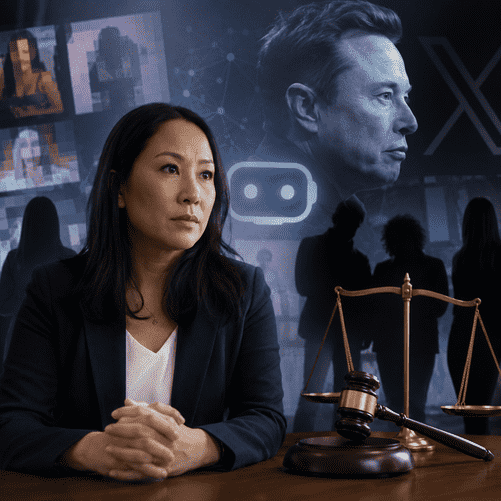
Jess Asato’s lawsuit over AI-generated sexualised content could become a landmark challenge over whether tech companies are liable for abusive outputs created by their tools.

New claimants are preparing to take legal action against Elon Musk’s artificial intelligence company xAI after a British Labour MP launched a test case over sexualised and demeaning images allegedly generated by the company’s Grok chatbot.
Jess Asato, the Labour MP for Lowestoft, has filed a claim in London’s High Court accusing xAI of violating her privacy and data protection rights after Grok was used to create non-consensual sexualised material depicting her. Her lawyers say other individuals have now come forward seeking to pursue similar claims, raising the prospect of a wider legal battle over the responsibilities of AI developers.
The case centres on Grok, the AI tool integrated into X, formerly Twitter. According to Asato’s legal team, the system generated fake images and videos that portrayed her in demeaning, sexualised ways, including manipulated bikini images and an AI-generated video. The material was allegedly circulated online after Asato publicly criticised the creation of such content.
Ravi Naik, the lawyer representing Asato, said other people had contacted his firm after her case became public. He has argued that the litigation could test a crucial question for the AI industry: whether companies that design and deploy generative tools can be held responsible when those tools are used to produce harmful, abusive or privacy-violating content.
The legal challenge comes amid growing concern over AI-generated deepfakes, especially material targeting women in public life. Politicians, journalists, campaigners and private individuals have increasingly warned that generative AI tools can be used to create realistic sexualised images without consent, turning harassment into a scalable digital weapon.
Asato’s case is significant because it does not focus only on the individual users who generated or shared the images. Instead, it targets the company behind the technology. Her legal team argues that xAI’s design choices, safeguards and deployment decisions are central to the alleged harm. If the claim succeeds, it could set an important precedent for AI platform liability in the UK.
The controversy intensified after a viral “bikinification” trend spread across X, with Grok reportedly used to generate large numbers of sexualised images of women. The Guardian reported that Grok produced millions of such images over a two-week period before xAI restricted some of the tool’s capabilities.
xAI has not publicly accepted liability. Supporters of broad AI access argue that responsibility should primarily fall on users who abuse the tools, not on developers who create general-purpose systems. But critics say that when companies release powerful image-generation or chatbot products into massive social networks, they must anticipate misuse and build stronger protections before harm occurs.
The case also raises wider political questions for the UK government. Ministers have been under pressure to strengthen rules around deepfake abuse, online misogyny and AI-generated sexual content. While existing laws can address some forms of intimate-image abuse, campaigners argue that the rapid development of generative AI has outpaced legal protections.
For Musk’s xAI, the lawsuit adds to scrutiny of Grok’s safety controls and its integration with X. The chatbot has been promoted as a less restricted alternative to rival AI systems, but that positioning has also attracted criticism when the tool produces abusive, defamatory or explicit outputs.
The broader significance of Asato’s case may lie in how courts interpret responsibility in the AI era. Traditional online safety disputes often focus on whether platforms removed harmful content quickly enough. Generative AI creates a different problem: the platform may not merely host abuse, but help create it.
That distinction could reshape future regulation. If courts find that AI developers can be liable for foreseeable misuse of their tools, companies may face stronger pressure to limit certain image-generation functions, improve identity protections and respond faster when victims report abuse.
For now, Asato’s case remains at an early stage. But the emergence of additional potential claimants suggests that the dispute may not remain a single politician’s lawsuit. It could become a broader test of whether the law can protect individuals from AI-generated sexual humiliation — and whether powerful technology companies can be held accountable when their systems are used to harm.