Project Solara signals a shift from app-based devices to “agent-first” hardware designed to listen, recognize context and assist workers in real time.

Microsoft is moving deeper into the race to define the next generation of artificial intelligence hardware, unveiling Project Solara, a new platform designed to power devices built around AI agents rather than traditional apps.
The initiative reflects a broader shift in the technology industry. After years in which smartphones, laptops and cloud software dominated digital work, major companies are now trying to build smaller, more ambient devices that can follow workers through daily tasks, respond to context and automate routine decisions. Microsoft’s answer is not a new consumer gadget, but a platform for manufacturers and enterprise customers to build “agent-first” devices for the workplace.
Project Solara is built as a chip-to-cloud system. That means the intelligence of the device is not limited to the hardware itself. Instead, lightweight gadgets can connect to cloud-based AI agents, enterprise data and centralized management tools. Microsoft is positioning the system as a foundation for a new generation of workplace devices that do not behave like conventional computers. Rather than opening applications, users would interact with AI assistants that understand the task, the environment and the worker’s role.
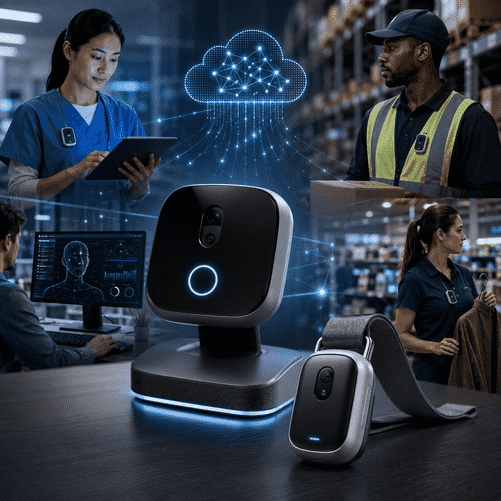
The company has shown two reference concepts: a desk-mounted AI hub and a wearable badge. The desk device is designed for stationary work environments, using features such as presence detection and biometric authentication to give workers access to AI agents. The wearable badge, aimed at frontline sectors such as retail, healthcare and field service, could support functions like capturing information, transcribing conversations, verifying identity and helping workers access company systems hands-free.
The wearable badge may be the most important signal of where Microsoft believes workplace computing is heading. In industries where employees are not seated at desks, smartphones are often inconvenient and laptops are impractical. A lightweight badge or body-worn AI device could become a bridge between physical work and digital systems, allowing workers to retrieve information, document tasks or communicate with software without stopping what they are doing.
Unlike many earlier experiments in wearable technology, Microsoft is focusing first on the enterprise market rather than the consumer market. That strategy is significant. Consumers have shown mixed reactions to AI gadgets, especially when privacy, cameras and always-on microphones are involved. Businesses, however, may be more willing to adopt controlled devices if they improve productivity, safety or customer service.
The platform also shows how Microsoft is trying to avoid repeating the mistakes of past hardware efforts. Project Solara is not built around Windows, nor is Microsoft trying to manufacture the devices itself. Instead, the company is offering reference designs and a software architecture that partners can adapt. Qualcomm and MediaTek are involved on the silicon side, giving manufacturers a path to build smaller and more efficient AI devices.
The timing is important. The technology industry is searching for the next major interface after the smartphone. Meta is investing heavily in smart glasses, Google is expanding AI across Android and wearables, and OpenAI’s acquisition of Jony Ive’s hardware startup has intensified speculation about a new category of AI-native consumer devices. Microsoft’s approach is more practical and enterprise-focused, but it belongs to the same race: the effort to make AI move beyond the screen.
Still, the challenges are considerable. Wearable AI devices must solve problems around privacy, battery life, security and user trust. A badge that can listen, observe or transcribe workplace interactions may be useful, but it also raises questions about surveillance and data control. Microsoft will need to convince companies, employees and regulators that these devices can be managed responsibly.
There is also the question of whether workers actually want another device attached to their bodies. The success of Project Solara will depend not only on technical performance, but on whether the hardware feels useful rather than intrusive. If the devices reduce friction and help employees do their jobs faster, adoption could grow quickly. If they feel like monitoring tools, resistance may follow.
Project Solara is therefore more than a product announcement. It is a statement about the future of work. Microsoft is betting that AI will not simply live inside chat windows or office software. It will become an invisible layer across devices, environments and workflows.
The next workplace computer may not look like a computer at all. It may be a badge, a small screen, a camera-enabled assistant or a device that disappears into the background while AI agents do the visible work. With Project Solara, Microsoft is trying to make sure that when that shift arrives, it controls the platform beneath it.