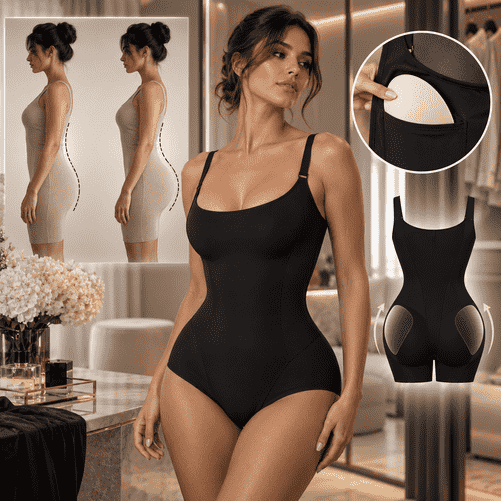
The British high-street stalwart is moving beyond traditional slimming shapewear with removable hip pads designed to add curves, reflecting a broader fashion shift toward engineered silhouettes and body enhancement.

Marks & Spencer has entered a new phase of the shapewear market with a £28 bodysuit designed not to make the body look smaller, but to make parts of it look bigger.
The retailer’s new “Body Sculpt Hip Boost All In One” combines firm compression around the waist and stomach with removable padding at the hips, allowing wearers to create a more pronounced hourglass silhouette. The product is designed to be worn with the customer’s own bra and includes adjustable straps, stretch fabric and M&S’s cooling technology.
It is a striking reversal of what shapewear traditionally promised.
For decades, the category was largely built around reduction: flatten the stomach, smooth the waist, compress the thighs and minimise visible lines. The latest generation of garments increasingly does something more complicated. It compresses in one place while adding volume somewhere else.
M&S’s new bodysuit reflects that transition particularly clearly.
The removable pads sit inside pockets around the hips and function somewhat like bra inserts, enabling the wearer to change the outline of the body without surgery or permanent alteration. The result is a more exaggerated waist-to-hip ratio — a silhouette that has become strongly associated with celebrity culture and, most visibly, the Kardashian era.
The timing is significant.
For years, Kim Kardashian’s Skims brand has helped transform shapewear from a discreet underwear category into a fashion business in its own right. Products that lift, contour and strategically enhance the body have become part of mainstream style rather than something consumers are expected to conceal or feel embarrassed about buying.
Skims itself has expanded into products incorporating padding around the hips and buttocks alongside compression elsewhere, making body enhancement a deliberate design feature rather than a by-product of shaping fabric.
M&S is now bringing a similar concept to the British mass market at a comparatively accessible price.
That matters because the retailer occupies a very different position from celebrity-led fashion brands.
Marks & Spencer is one of Britain’s most established clothing businesses, historically associated as much with dependable underwear and wardrobe basics as with fashion experimentation. Its decision to sell exaggerated hip enhancement is therefore evidence that the aesthetic has moved well beyond social-media niches.
The product also fits into a wider transformation taking place inside M&S.
The company has spent several years attempting to refresh its fashion credentials and attract younger, more style-conscious shoppers. It is preparing to appear at London Fashion Week as part of the centenary of its fashion business, a move that would once have seemed improbable for a retailer long criticised for looking conservative or dated.
Chief executive Stuart Machin has openly discussed the effort to move M&S beyond its former “frumpy” image and reposition it as a credible high-street fashion destination. The company’s recent collections have leaned more heavily into contemporary silhouettes, trend-driven tailoring and seasonal statement pieces.
The hip-boost bodysuit is another expression of that ambition.
But it also points toward something larger happening in fashion: the body itself is increasingly being treated as an adjustable silhouette.
Historically, clothing has always manipulated proportions.
Corsets narrowed waists. Crinolines expanded skirts. Bustles pushed fabric outward at the back. Eighteenth-century panniers created dramatically widened hips.
Contemporary shapewear is, in many ways, reviving the same idea with modern materials.
Recent couture collections from designers including Schiaparelli and Dior have experimented with exaggerated hips and sculpted proportions, bringing architectural silhouettes back onto the runway. The difference is that the structure is now often concealed beneath relatively ordinary clothing rather than openly displayed.
What looks like a natural body shape may therefore be increasingly engineered by what sits underneath it.
The rise of padded shapewear also reflects the extraordinary influence celebrity aesthetics have had on ideas of physical attractiveness over the past decade.
The very thin, relatively straight silhouettes associated with parts of 1990s and early-2000s fashion were gradually displaced by an aesthetic that emphasised narrow waists combined with fuller hips and buttocks.
Social media accelerated the shift.
Instagram, TikTok and other visual platforms created an environment in which highly specific body proportions could be repeatedly presented as desirable, while celebrity figures helped turn the hourglass shape into a global commercial aesthetic.
Fashion companies followed.
What once might have required tailoring or cosmetic intervention can increasingly be simulated with bras, padded underwear, compression garments and carefully constructed clothing.
That has made body transformation both cheaper and more reversible.
For consumers who want the look without surgery, removable padding offers an obvious appeal.
The £28 M&S bodysuit allows users to effectively switch the effect on or off.
Remove the pads and the garment functions largely as conventional firm-control shapewear.
Insert them and the proportions change.
That reversibility may be one of the product’s strongest selling points, particularly at a time when beauty ideals appear to be changing more rapidly than ever.
The Kardashian-inspired hourglass remains influential, but fashion is simultaneously experiencing renewed interest in thinner silhouettes, low-rise clothing and aesthetics borrowed from the early 2000s.
Some commentators have even suggested that the dramatic curves associated with the previous decade are becoming less dominant.
The existence of products such as M&S’s hip booster demonstrates that contemporary consumers do not necessarily have to choose between those ideals permanently.
The body can increasingly be styled almost like clothing.
That idea is not without controversy.
Psychologists, academics and body-image campaigners have repeatedly questioned the effect of constantly changing physical ideals on women in particular.
Sociologist Victoria Pitts-Taylor and psychotherapist Susie Orbach, speaking to The Guardian about the trend, highlighted the pressure created when bodies are repeatedly presented as projects that must be reshaped to satisfy whatever silhouette is currently fashionable.
The problem is less about any single shape being inherently undesirable than the relentless demand for modification.
When one decade celebrates extreme thinness, another exaggerated curves and another athletic definition, consumers can be encouraged to perceive normal physical variation as something requiring correction.
That tension has intensified because fashion trends now coexist with rapidly expanding cosmetic procedures and pharmaceutical weight loss.
Brazilian butt lifts, liposuction, fillers and other forms of cosmetic intervention have become considerably more visible in popular culture, while drugs originally developed to treat diabetes and obesity have altered the broader conversation around weight and body shape.
Clothing sits at the least permanent end of that spectrum.
A padded bodysuit may appear relatively benign precisely because it offers transformation without medical intervention.
But it participates in the same cultural logic: the idea that silhouette is something that can be continually redesigned.
For retailers, that is also a commercial opportunity.
Shapewear has become a substantial fashion category, with brands competing not only on compression but on comfort, invisibility, lift and increasingly enhancement.
M&S already offers a wide selection of shaping bodysuits, including firm-control, high-leg and waist-focused designs, alongside products from Spanx and Miraclesuit. Its own assortment now includes garments explicitly marketed for boosting the bust and buttocks as well as the new hip-enhancing design.
The language itself is changing.
“Control” remains important, but so do “boost,” “sculpt,” “define” and “enhance.”
Those terms describe a category that is no longer simply hiding perceived imperfections.
It is manufacturing proportions.
That may explain why the comparison with Kardashian-style shapewear is so immediate.
Kim Kardashian did not invent padded underwear or the hourglass silhouette, but her enormous cultural influence helped make dramatically sculpted proportions part of mainstream global fashion.
Skims then turned that visual language into a commercial system of underwear, bodysuits and shaping products.
M&S’s £28 interpretation demonstrates how thoroughly the concept has travelled.
What begins with celebrity aesthetics often eventually reaches the mass market, stripped of exclusivity and offered at high-street prices.
And that is arguably the most interesting aspect of the new bodysuit.
It is not merely another piece of underwear.
It shows how rapidly once-extreme beauty trends can become normal retail propositions.
A product designed specifically to enlarge the appearance of the hips would have looked unusual on the British high street not very long ago.
Today it sits inside the shapewear department of Marks & Spencer.
The broader message from fashion is increasingly clear: modern shapewear is no longer simply asking, “What would you like to hide?”
It is asking something much more ambitious.
“What shape would you like to be today?”