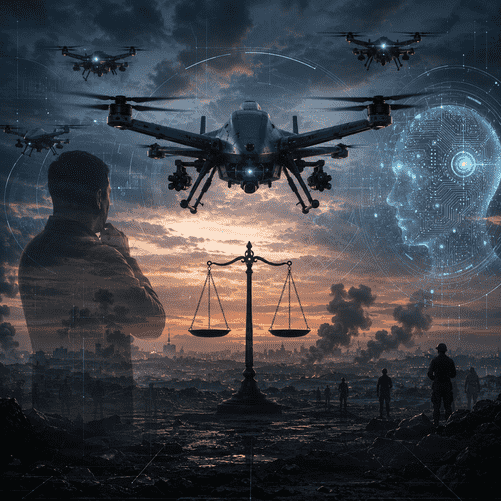
AI-powered weapons are becoming central to modern warfare, but the question of whether machines can make ethical life-and-death decisions remains unresolved.

Autonomous drones are moving from the margins of military technology toward the centre of modern warfare, promising faster targeting, cheaper operations and reduced risk to soldiers. But as artificial intelligence becomes more deeply embedded in weapons systems, one question is becoming impossible to avoid: can a machine be trusted to make a moral decision about who lives and who dies?
The issue is no longer theoretical. AI-assisted and semi-autonomous weapons are already being used in conflicts from Ukraine to the Middle East, where drones, loitering munitions and automated targeting tools have reshaped the battlefield. These systems can identify objects, track movement, process surveillance data and in some cases operate with limited human intervention. The next step — fully autonomous lethal force — remains one of the most contested frontiers in military technology.
Supporters argue that autonomous weapons could make warfare more precise. In theory, AI systems can process battlefield information faster than humans, detect threats in complex environments and reduce the emotional impulses that can lead to unlawful killings. A drone that never panics, tires or seeks revenge could, advocates say, become a more disciplined combatant than a human soldier.
But critics warn that this argument mistakes calculation for morality. Artificial intelligence can classify patterns, compare data and follow programmed rules. It cannot understand human dignity, mercy, proportionality or the moral weight of killing. The central ethical problem is not whether a drone can identify a target, but whether it can understand why a target should or should not be attacked.
International humanitarian law already requires distinction between combatants and civilians, proportionality in the use of force, and precautions to avoid unnecessary harm. States generally agree that these rules apply to autonomous weapons, but there are still no binding international standards specifically governing lethal autonomous weapons systems. Talks in Geneva have made limited progress, while major military powers remain divided over whether new treaties are needed or whether existing law is enough.
The United Nations has repeatedly warned that so-called “killer robots” raise profound ethical, legal and security questions because they could identify, select and attack human targets without direct human intervention. UN officials have called for a legally binding instrument on autonomous weapons, with the secretary-general urging states to act by 2026.
The debate has intensified as governments accelerate military AI development. The White House recently announced plans to speed up the use of AI for national security, while directing the Pentagon to update policies on autonomous weapons and ensure they remain aligned with legal and command-chain safeguards. At the same time, U.S. lawmakers have proposed legislation aimed at creating stronger rules for defense AI and autonomous weapon systems.
The core disagreement is often described as the question of “meaningful human control.” Should a human commander always approve a lethal strike? Is it enough for a person to set the mission parameters before launch? Or can responsibility be preserved if a machine acts independently within pre-programmed limits?
These questions become harder as warfare accelerates. Swarms of drones may operate too quickly for real-time human approval. Defensive systems may need to respond in seconds to incoming missiles or drones. In such conditions, militaries argue that autonomy may be operationally necessary. But the faster the battlefield becomes, the more human judgment risks being pushed out of the loop.
Accountability is another unresolved problem. If an autonomous drone mistakenly kills civilians, who is responsible? The commander who deployed it? The programmer who designed the model? The company that trained it? The state that bought it? Or no one at all? Critics fear that autonomous weapons could create an accountability gap, where blame is dispersed across technical systems and institutions until moral responsibility disappears.
Technical risks deepen the concern. AI systems can fail in unpredictable ways, especially in chaotic environments filled with smoke, damaged infrastructure, electronic warfare, poor visibility, deception and incomplete data. Researchers have warned that autonomous weapons may suffer from black-box decision-making, unreliable classification, goal misgeneralization and unexpected behaviour in real combat conditions.
That unpredictability matters because war is not a laboratory. A person carrying a rifle may be a soldier, a civilian fleeing violence, a police officer, a farmer, or a wounded combatant no longer posing a threat. A vehicle may be a military target or an ambulance. A building may be a command post or a shelter. Human soldiers can also make tragic mistakes, but they can interpret context, hesitation, surrender and fear in ways machines cannot reliably replicate.
Public opinion appears to reflect that unease. Recent research across nine countries found that people are not categorically opposed to all military uses of AI, but concern rises sharply when systems are given authority to use lethal force fully autonomously. In other words, the public may accept AI as a tool for surveillance, logistics or decision support, while remaining deeply uncomfortable with machines deciding to kill.
Some ethicists argue that the answer is not a total ban, but strict design and deployment limits. Autonomous systems could be restricted to non-human targets, such as incoming missiles, drones, mines or unmanned vehicles. They could operate only in clearly defined zones, for limited periods, with auditable decision logs and human override mechanisms. Others argue that any system capable of selecting and killing human beings without direct human approval should be prohibited outright.
The military pressure to adopt such systems will be difficult to resist. Autonomous drones are cheaper than fighter jets, easier to produce at scale and increasingly effective against tanks, ships, radar sites and infantry positions. Nations that fear falling behind rivals may conclude that ethical restraint is a strategic luxury they cannot afford.
That is the danger. If one state deploys increasingly autonomous weapons, others may feel compelled to follow. The result could be an arms race in which speed, automation and deniability become more valuable than judgment, restraint and accountability.
The question, then, is not only whether killer drones can take morality onboard. It is whether human societies can build political and legal systems strong enough to keep morality in command.
For now, the answer remains uncertain. AI can assist soldiers, improve surveillance and perhaps reduce some forms of battlefield error. But morality is not a software update. Until machines can understand the value of human life — and until humans can clearly assign responsibility for machine-made deaths — the decision to kill should remain a human one.