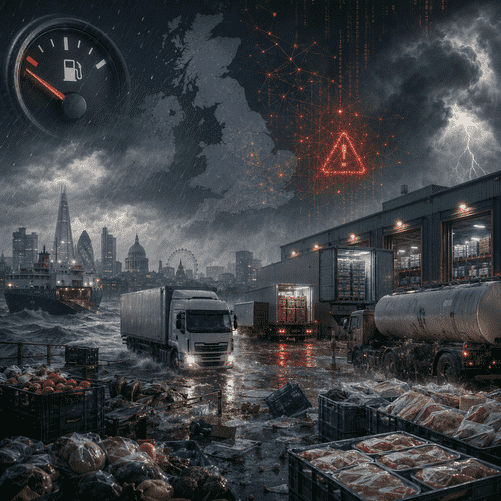
Cold storage and logistics leaders warn that fuel shortages, cyberattacks and extreme weather could expose serious weaknesses in Britain’s food system.

British ministers are facing fresh accusations of complacency over the resilience of the country’s food supply, after the cold storage and logistics industry warned that disruption to fuel, power, digital systems or ports could quickly threaten supermarket shelves and essential services.
The Cold Chain Federation, which represents businesses involved in storing and transporting temperature-sensitive food, medicines and vaccines, has urged the government to treat food-supply resilience as an “immediate national priority.” Its warning reflects growing concern that Britain’s food system, although highly efficient in normal conditions, may be dangerously exposed to shocks ranging from cyberattacks and extreme weather to geopolitical disruption and fuel shortages.
At the heart of the warning is the cold chain: the network of refrigerated warehouses, lorries and distribution hubs that keeps meat, fish, dairy products, fruit, vegetables, ready meals, medicines and vaccines safe before they reach retailers, hospitals, schools, care homes and households. If that network fails, the consequences could be rapid and visible.
Industry leaders argue that the UK’s food infrastructure has become too dependent on just-in-time logistics, imported food flows and privately operated storage systems. Britain imports more than a third of its food, much of it moving through a limited number of major ports. That concentration, combined with the growing frequency of climate-related disruption, leaves the system vulnerable to sudden interruption.
The risk is not theoretical. Recent years have already shown how quickly pressure can build. Poor weather in Europe and north Africa contributed to shortages of tomatoes, cucumbers and peppers in 2023, while the pandemic and the war in Ukraine exposed weaknesses in energy, labour and fertiliser supply chains. More recently, concerns over global shipping routes, fuel costs and fertiliser availability have added to fears that international shocks could feed directly into domestic food availability and prices.
The federation has also warned that cold-chain companies are facing persistent cyber threats. Refrigerated logistics depend heavily on digital systems to manage temperature, stock movement, transport routing and warehouse operations. A successful cyberattack on a major cold-storage operator or food distribution hub could disrupt deliveries and lead to the loss of perishable goods.
Extreme weather is another growing concern. Flooding can damage warehouses and roads, while intense heat can increase energy demand and strain refrigeration systems. Power outages, even short ones, can have severe consequences for chilled and frozen goods. For the industry, this raises a basic question: if cold stores and food transport hubs are essential to national life, why are they not treated with the same urgency as other critical infrastructure?
The Cold Chain Federation is calling for a clearer national resilience plan. Its proposals include designating cold stores and food transport hubs as critical infrastructure, ensuring power supplies are protected during major outages, giving key logistics workers permanent essential-worker status, and placing responsibility for cold-chain resilience at the heart of government, including the Cabinet Office.
The government has rejected suggestions that it is ignoring the issue. Officials say the food sector is already classified as one of the UK’s critical national infrastructure sectors, and that ministers are investing in domestic food production, agricultural technology and climate-resilient crops. The government argues that strengthening British farming and improving adaptability across the food system remain central to its strategy.
But critics say that broader recognition of the food sector is not enough. They argue that the most fragile points of the system — refrigerated storage, transport hubs, fuel access, port flows and energy-dependent logistics — need specific protection. Without that, they warn, the UK could find itself reacting to a crisis rather than preparing for one.
The debate comes at a time when food security is increasingly being viewed not only as an agricultural issue, but as a national-security challenge. A modern food system depends on energy, transport, digital networks, labour, imports and climate stability. Failure in any one of those areas can quickly create pressure across the entire chain.
For households already facing high food prices, the consequences of disruption would be severe. Shortages tend to hit low-income families hardest, particularly when prices rise or fresh produce becomes less available. Schools, hospitals and care homes would also be exposed if refrigerated deliveries were interrupted.
The warning from the cold-chain industry is therefore more than a sectoral complaint. It is a challenge to the way Britain thinks about resilience. For decades, efficiency has shaped the country’s food logistics system. Now, amid climate volatility, geopolitical instability and rising cyber risk, the question is whether efficiency alone is enough.
Britain’s food supply has not collapsed. But the message from the logistics sector is clear: the system is under growing strain, and the time to strengthen it is before a major shock arrives, not after.