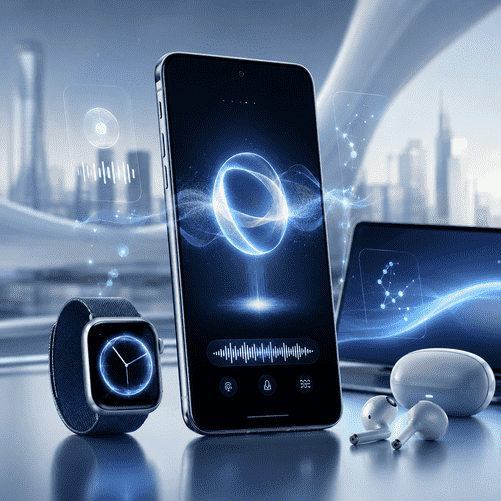
The company’s long-awaited assistant overhaul aims to bring generative AI deeper into the iPhone ecosystem, but European users may have to wait.

Apple has unveiled a major redesign of Siri, turning its once-limited voice assistant into a more conversational, context-aware AI system designed to operate across the company’s devices and apps.
Announced at Apple’s Worldwide Developers Conference on June 8, 2026, the new “Siri AI” is one of the company’s most important artificial intelligence moves to date. After years of criticism that Siri had fallen behind rival assistants and chatbots, Apple is now trying to reposition the iPhone not just as a device that runs apps, but as a personal computing platform guided by an intelligent assistant.
The new Siri is designed to understand personal context, respond in more natural dialogue, interpret what is happening on screen, and help users retrieve information from messages, emails, photos and other parts of their digital life. Apple presented the upgrade as part of a broader expansion of Apple Intelligence, its privacy-focused AI framework for iPhone, iPad, Mac, Apple Watch and Vision Pro.
The move comes at a critical time for the technology industry. Generative AI is rapidly changing how users interact with phones, computers and wearables. Google has pushed Gemini deeper into Android, Samsung has promoted Galaxy AI across its flagship smartphones, and OpenAI, Meta and other companies are racing to build AI assistants that can handle increasingly complex tasks. Apple, by contrast, has been cautious, prioritising privacy and device integration over speed.
That caution is now becoming a strategic test. Apple’s advantage is enormous: hundreds of millions of users already carry iPhones, wear Apple Watches, use AirPods and store deeply personal information inside the company’s ecosystem. If Siri AI works well, Apple could make artificial intelligence feel less like a separate chatbot and more like an invisible layer across everyday devices.
But the launch also exposes Apple’s growing regulatory problem in Europe. The company said Siri AI will not be available on iPhone and iPad in the European Union when iOS 27 and iPadOS 27 are released. Apple blamed the delay on the EU’s Digital Markets Act, saying it has not yet found a way to offer the new assistant while meeting European regulatory demands and preserving user security.
That means one of Apple’s most important AI upgrades may arrive unevenly across global markets. Users in the United States and other regions are expected to see Siri AI first, while EU iPhone owners may be left waiting for an uncertain timeline. The split highlights a wider tension between Silicon Valley’s push for AI integration and Europe’s effort to control the power of dominant digital platforms.
For Apple, the stakes go beyond Siri. The company is trying to defend the iPhone’s central role in consumer technology at a moment when many executives believe AI-powered wearables, smart glasses and ambient assistants could eventually reduce dependence on traditional smartphone screens. A more capable Siri could help Apple extend the iPhone era by making the device smarter, more proactive and harder to leave.
The redesigned assistant also gives Apple a stronger bridge into wearables. If Siri AI can understand context across Apple Watch, AirPods and Vision Pro, the company could turn those devices into more useful AI interfaces. Voice, vision and personal data would become the foundation for a new kind of computing experience — one that is less about opening apps and more about asking for outcomes.
Still, Apple must prove that its AI can deliver in real life. Users have heard promises about smarter assistants before, and Siri’s reputation has suffered from years of limited usefulness. The new version will be judged not by keynote demonstrations, but by whether it can reliably handle everyday tasks without confusion, delay or privacy concerns.
Apple’s announcement does not end the AI race. It marks the moment the race becomes more personal. The next battleground is no longer only the chatbot window or the search bar. It is the smartphone in the user’s hand, the watch on the wrist, and the assistant that knows enough to be useful — but not so much that it becomes unsettling.