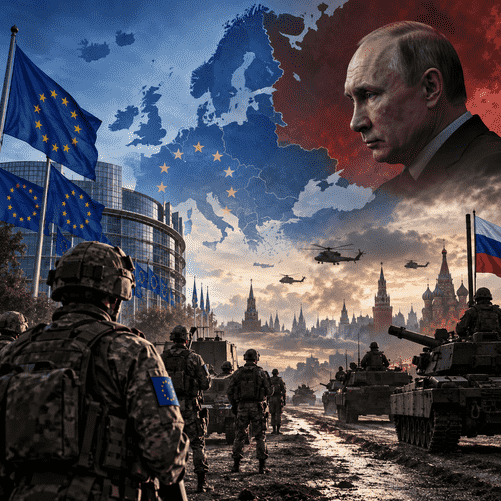
In a wide-ranging interview, Ukraine’s president struck an unusually upbeat tone, accusing Putin of deception, urging Europe to strengthen air defence, and offering Kyiv’s drone-warfare expertise to its allies.

Ukrainian President Volodymyr Zelenskyy has claimed that Russia is increasingly isolated on the international stage, arguing that Vladimir Putin’s war strategy is built on lies and that Moscow is losing influence across Europe and beyond.
In a wide-ranging interview with the Guardian, Zelenskyy presented a defiant and relatively upbeat assessment of Ukraine’s position, despite continued Russian attacks, uncertainty over American support, and the grinding pressure of a war now defined by drones, missiles and attrition.
“They are isolated,” Zelenskyy said of Russia, suggesting that Moscow’s political defeats and shrinking network of reliable partners have weakened its global position. His message was clear: Putin may still be able to launch missiles and sustain battlefield pressure, but Russia’s diplomatic space is narrowing.
The Ukrainian leader accused Putin of lying from the beginning of the invasion, saying the Kremlin’s claims about protecting Russian speakers and justifying territorial conquest have served as a political glue inside Russian society. For Zelenskyy, the key question is not whether Putin believes his own narrative, but how effectively those lies are used to mobilise Russian public opinion and sustain the war.
That assessment comes as Ukraine seeks to maintain western unity at a difficult moment. Donald Trump’s return to the White House has changed the tone of US diplomacy, while Washington’s attention has also been pulled toward the Middle East. Zelenskyy said he had warned Trump that Putin was not negotiating in good faith and was trying to manipulate the White House.
At the same time, the Ukrainian president was careful not to directly alienate the United States. He expressed gratitude for American support, while making clear that Kyiv still needs more advanced air defence systems, especially Patriot batteries and interceptors capable of stopping Russian ballistic missiles.
The air war has become one of Ukraine’s most urgent challenges. Russian missile and drone attacks continue to target cities, infrastructure and civilians. Zelenskyy has renewed calls for European allies to help “close” Ukrainian skies, arguing that Europe cannot afford to treat Ukraine’s defence as a distant conflict.
Yet the interview also showed how Ukraine is no longer only a recipient of western military support. After more than four years of full-scale war, Kyiv has become one of the world’s most experienced centres of drone warfare. Ukrainian forces have used drones for surveillance, battlefield strikes, naval attacks, long-range operations and air defence adaptation.
Zelenskyy said Ukraine is prepared to share this experience with western allies, including Britain and NATO partners. This is one of Kyiv’s strongest arguments for deeper integration with Europe: Ukraine is not simply asking for help, but offering battlefield knowledge that western militaries do not possess at the same scale.
That expertise has become strategically valuable. The war has transformed drones from auxiliary tools into central weapons of modern conflict. Cheap, fast-adapted systems now shape front-line tactics, logistics, air defence and deep-strike operations. Ukraine’s lessons are likely to influence future NATO planning, procurement and military doctrine.
Zelenskyy also discussed Britain’s symbolic role in supporting Ukraine. He said he would like King Charles to visit Ukraine, describing the monarch as supportive of the Ukrainian cause. Such a visit would carry political and emotional weight, reinforcing Britain’s place among Kyiv’s most visible allies.
The broader message of the interview was one of endurance. Zelenskyy did not claim that victory was near, nor did he minimise the scale of Russia’s attacks. But he framed the war as a contest in which Russia’s battlefield brutality is increasingly matched by political isolation, while Ukraine’s survival has turned into a source of strategic knowledge for the West.
His argument is that Putin’s Russia remains dangerous, but not unstoppable. Moscow can still destroy, threaten and deceive. But Ukraine, Zelenskyy suggested, has learned how to resist — and now wants Europe to learn from that resistance before the next war arrives.