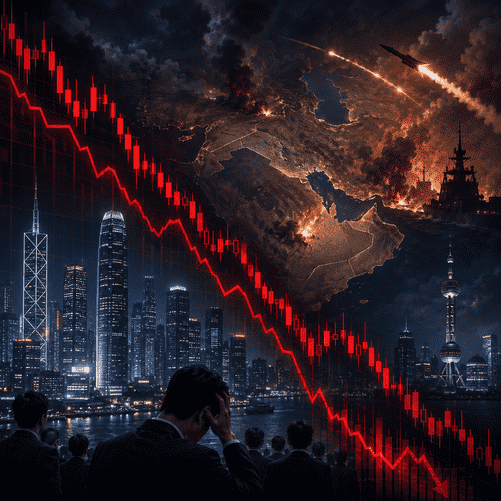
Investors retreat from risk after Washington strikes Iran and Tehran retaliates against US-linked targets across the Gulf and Jordan

Asian stock markets fell sharply on Wednesday after the United States and Iran exchanged their most serious round of fire since a ceasefire was agreed in April, shaking investor confidence and reviving fears of a wider conflict across the Middle East.
The sell-off followed US strikes on Iranian targets near the Strait of Hormuz, one of the world’s most important energy corridors. Washington said the operation came after President Donald Trump blamed Tehran for the downing of a US Army Apache helicopter near the strait. The helicopter’s crew was reportedly rescued, but the incident triggered a rapid escalation between the two countries.
Iran responded early Wednesday with missile and drone attacks aimed at US-linked military sites in Kuwait, Bahrain and Jordan. Tehran described the strikes as retaliation for the American operation, while regional authorities said several attacks were intercepted and no major casualties were immediately reported.
The military exchange rattled Asian markets, where investors moved quickly out of equities and into safer assets. Japan’s Nikkei dropped, South Korea’s Kospi came under heavy pressure, and broader regional indices also weakened as traders assessed the risk of further escalation.
The Strait of Hormuz remains at the centre of market concern. Any prolonged disruption in the area could threaten global oil flows, push energy prices higher and add new pressure to inflation, just as central banks are weighing the future path of interest rates. Although oil prices initially moved only modestly, analysts warned that markets could react more sharply if the conflict expands or if shipping routes are directly affected.
The confrontation also places renewed strain on the fragile ceasefire reached in April. That agreement had eased some fears of a broader regional war, but Wednesday’s exchange suggested that the truce may now be close to collapse.
For investors, the danger is not only military escalation but also economic contagion. Higher energy costs would hit import-dependent Asian economies particularly hard, while renewed geopolitical instability could weaken business confidence, disrupt supply chains and complicate monetary policy decisions across the region.
European markets opened more cautiously, but the mood remained fragile. Traders are also watching upcoming US inflation data, which could become even more significant if Middle East tensions translate into higher fuel and transport costs.
Washington has signalled that its strikes were limited, while Tehran has warned that further attacks will be answered. That leaves financial markets facing a familiar but dangerous uncertainty: whether this exchange remains a contained military episode, or marks the beginning of a broader confrontation with global economic consequences.