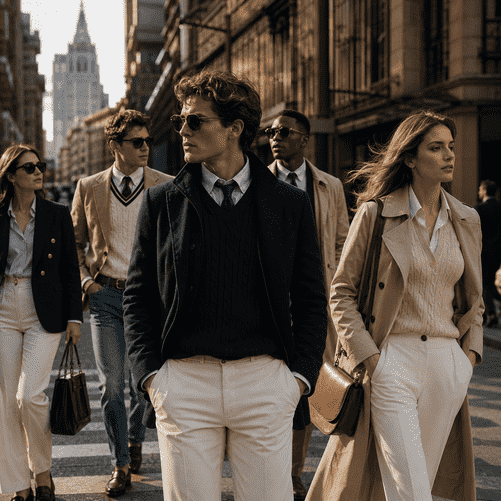
Ralph Lauren, Coach and Tommy Hilfiger are returning to the centre of New York fashion as younger consumers embrace polished Americana, familiar icons and products that feel enduring rather than disposable.

Fashion’s next major trend may not look particularly new.
As New York Fashion Week prepares to open, some of the strongest momentum in American fashion is gathering around labels whose identities were established decades before many of their newest customers were born.
Ralph Lauren. Coach. Tommy Hilfiger.
Brands built on polo shirts, leather bags, collegiate knits, equestrian references and an idealised vision of American life are finding themselves unexpectedly aligned with the tastes of a generation once assumed to be more interested in streetwear, experimental labels and ultra-fast digital fashion.
The revival will be unusually visible during New York Fashion Week, where Ralph Lauren and Coach are scheduled to stage shows immediately before the official programme begins, while Tommy Hilfiger returns after an absence. More than 70 runway shows and presentations are expected during the event, which runs through September 15.
The resurgence arrives at a complicated moment for luxury.
European luxury stocks fell again this week as investors questioned the strength of the industry’s recovery. LVMH shares dropped to their lowest level since 2020, while Hermès, Kering, Brunello Cucinelli, Richemont and Burberry also declined. The STOXX Europe Luxury 10 index is down about 19% this year.
Yet amid that weakness, several American heritage brands are doing something much of the luxury sector has struggled to achieve.
They are convincing young consumers to care about them again.
The Return of the Polo Shirt
Few companies illustrate the transformation better than Ralph Lauren.
Founded in 1967, the company spent decades turning an imagined version of American aristocratic life into one of the world’s most recognisable fashion identities.
Polo shirts, cable-knit sweaters, Oxford shirts, riding jackets, loafers and collegiate sportswear became visual shorthand for the brand.
Those products never disappeared.
What changed was their cultural relevance.
Today, younger shoppers in North America and Asia are rediscovering the Ralph Lauren aesthetic through a combination of nostalgia, social media and renewed interest in classic dressing.
The effect is visible in the company’s financial performance.
Ralph Lauren reported first-quarter revenue of $1.96 billion, ahead of analysts’ expectations of $1.87 billion. Sales rose 13% in North America and 24% in Asia, including growth of more than 40% in China.
The company has deliberately pushed itself further upmarket while refreshing familiar products rather than abandoning them.
Cable-knit sweaters appear in new proportions and colours. Traditional fleece and sweatshirts are being redesigned for younger customers. Polo shirts, blazers and structured outerwear fit neatly into a broader move away from aggressively casual pandemic-era dressing.
What once risked appearing conservative now feels desirable again.
Fashion is rediscovering the appeal of looking dressed.
Coach Finds Its Second Youth
Coach offers perhaps an even clearer example of how heritage can be successfully repackaged.
The New York leather-goods company was once associated with practical handbags and accessible American luxury. By the 2010s, however, heavy discounting and outlet exposure had diluted some of its prestige.
Its recent revival has been built around a different strategy.
Instead of chasing every possible consumer, Coach has concentrated on fewer, recognisable products and increasingly sophisticated cultural marketing.
The Tabby bag has become central to that transformation.
Its rounded silhouette and prominent “C” hardware reference archival Coach designs, but social media, celebrity placement and new materials have turned it into a distinctly contemporary product.
The strategy is working.
Sales at Coach rose 14% in Tapestry’s most recent quarter, while China grew 28% and Europe 19%. The performance contrasted sharply with sister brand Kate Spade, where sales declined 7%.
The divergence offers an important lesson for the broader luxury business.
Heritage alone is not enough.
Consumers must still be given a reason to desire it.
Coach has managed to turn its history into a design asset rather than simply a marketing slogan.
Tommy Hilfiger Returns
Tommy Hilfiger’s return to New York Fashion Week carries similar symbolic weight.
The company was one of the defining brands of American fashion during the 1990s, combining East Coast prep with hip-hop culture, sportswear and highly visible branding.
That combination gave Hilfiger unusual cultural reach.
It could appear equally comfortable in an Ivy League fantasy, a music video or on a Formula One paddock.
Now the brand is once again leaning heavily into that American identity.
Its recent collaboration with NFL star Travis Kelce illustrates the strategy: heritage fashion connected to contemporary sport, celebrity and entertainment.
Fashion market editor Tori López described Hilfiger’s return to the New York schedule as an important addition to the group of surviving American heritage brands.
The timing is significant.
Fashion has spent several years moving through cycles of maximalism, streetwear, quiet luxury and logo fatigue.
The current appetite increasingly appears to favour recognisable clothing with a strong cultural identity.
A rugby shirt does not require explanation.
Neither does a navy blazer, leather loafer, trench coat or cable-knit sweater.
That familiarity may be becoming part of their appeal.
Gen Z Discovers Its Parents’ Wardrobes
Much of the revival is being driven by Gen Z.
That might initially appear contradictory.
Younger consumers are simultaneously responsible for the popularity of ultra-fast fashion, resale platforms, experimental streetwear and highly fragmented internet aesthetics.
But Gen Z fashion culture is unusually comfortable combining contradictory influences.
A vintage Polo Ralph Lauren jacket can be worn with inexpensive trousers from a mass-market retailer.
A Coach handbag might accompany second-hand denim.
An old Hilfiger sweatshirt can be styled alongside contemporary sneakers.
Social media has weakened the traditional hierarchy separating luxury, vintage, streetwear and mainstream fashion.
Instead, consumers increasingly assemble identities from all of them.
That has created an unexpected advantage for heritage brands.
Their enormous archives provide decades of instantly recognisable designs ready to be rediscovered.
Fashion’s obsession with the next new thing is increasingly being replaced by the search for the next old thing.
The Appeal of Permanence
There is also an economic reason behind the trend.
Luxury consumers have become considerably more critical of value.
For years, leading fashion houses increased prices aggressively. Handbags costing €2,000 became €3,000 or €4,000. Entry-level products became increasingly inaccessible.
But quality and creativity did not always increase at the same pace.
As inflation and economic uncertainty reduced discretionary spending, consumers began questioning what exactly they were paying for.
That shift has become particularly uncomfortable for the European luxury industry.
On September 3, shares across the sector fell as analysts warned that demand remained fragile, particularly in the United States, Japan, South Korea and other Asian markets.
American heritage brands can occupy a useful position in that environment.
They offer status and recognisability without always demanding the pricing of European ultra-luxury houses.
Ralph Lauren, for example, operates across a remarkably broad spectrum.
A consumer can buy a polo shirt for a little over $100 or spend more than $5,000 on a Purple Label cashmere jacket.
That breadth gives the brand access to aspiring consumers while maintaining genuinely luxurious products at the top of the collection.
It also creates something luxury increasingly needs: a ladder.
Young customers can enter the brand relatively affordably and potentially trade upwards over time.
Quiet Luxury Evolves
The trend can also be understood as the next stage of “quiet luxury”.
The earlier quiet-luxury movement emphasised anonymous cashmere, neutral colours, understated tailoring and the absence of obvious logos.
Its visual heroes included brands such as The Row, Loro Piana and Brunello Cucinelli.
But that aesthetic eventually became so widely copied that quiet luxury itself developed a recognisable uniform.
The current heritage revival retains some of its principles — quality fabrics, classic silhouettes, restrained colours — while adding more personality.
Instead of anonymous minimalism, the new mood embraces recognisable references.
A cable-knit sweater.
A striped Oxford shirt.
A barn jacket.
A suede loafer.
A leather shoulder bag.
A university-style sweatshirt.
The clothes suggest continuity rather than novelty.
In uncertain times, that can be psychologically powerful.
Americana Becomes Global
Perhaps the most interesting aspect of the trend is that American heritage fashion is no longer primarily American.
Ralph Lauren’s extraordinary growth in China demonstrates how effectively the imagery travels.
The company staged its first Polo Cup in Beijing this year, transforming equestrian sport, tailoring and lifestyle branding into an immersive luxury experience. Chinese sales subsequently increased more than 40% in the latest quarter.
Coach has experienced similar international momentum.
Its growth in China and Europe suggests the new appetite for Americana is not simply a domestic US phenomenon.
The fantasy being sold is universal.
It is less about actual American geography than an imagined lifestyle: New England universities, Manhattan apartments, country estates, tennis clubs, ranches, convertibles and weekend houses.
Ralph Lauren mastered that form of storytelling decades ago.
The market appears to be rediscovering how powerful it can be.
Not Every Heritage Brand Wins
There is, however, an important warning hidden inside the trend.
Old brands do not automatically become fashionable again.
Michael Kors is also returning to the New York runway, yet the company has struggled with sluggish sales.
Kate Spade remains under pressure despite operating within the same Tapestry group that owns Coach.
The difference demonstrates that nostalgia must be carefully managed.
Too much familiarity can become irrelevance.
Too much discounting can damage exclusivity.
Too many products can obscure what a brand actually represents.
Coach’s recent success has depended partly on narrowing its focus around recognisable products and reducing indiscriminate promotions.
Ralph Lauren spent years restructuring distribution and moving away from lower-quality channels.
Heritage becomes valuable only when consumers believe it has been protected.
Luxury’s New Search for Meaning
The revival therefore says something larger about the state of fashion.
Luxury spent much of the past decade relying on scarcity, price increases and brand recognition.
That model has become less reliable.
Consumers, particularly younger ones, increasingly want a clearer emotional justification for expensive purchases.
Some are finding that justification in craftsmanship.
Others in sustainability or resale value.
Still others are finding it in history.
A garment connected to decades of design can feel more substantial than one engineered around a momentary trend.
That is precisely where heritage brands possess an advantage.
Their archives cannot easily be replicated.
New York’s Moment
New York Fashion Week will provide an unusually concentrated demonstration of this shift.
Ralph Lauren and Coach will lead the unofficial opening, followed by a schedule that includes Tommy Hilfiger, Calvin Klein, Carolina Herrera, Christian Siriano and Michael Kors.
Henry Zankov will present his first collection for Diane von Furstenberg, while London-based American designer Conner Ives will make his New York Fashion Week debut. Thom Browne is scheduled to close the event on September 15.
The mixture of established houses and younger designers reflects a fashion industry currently balancing two instincts.
One is the constant search for novelty.
The other is a renewed appreciation for continuity.
For the moment, continuity appears unusually powerful.
The hottest fashion proposition of 2026 may therefore be surprisingly simple.
A good sweater.
A well-cut blazer.
A familiar leather bag.
A polo shirt.
Clothes designed to look as though they could have been worn twenty years ago — and might still look appropriate twenty years from now.
For an industry built around relentless change, that may be the most significant trend of all.