Grief and anger sweep through Kuhestak after a deadly blast kills civilians at a Baloch wedding, intensifying scrutiny of the human cost of the widening US-Iran conflict

What should have been a night of celebration in the small coastal town of Kuhestak ended in devastation after an explosion struck a wedding gathering, killing civilians and injuring dozens in one of the most disturbing incidents of the latest escalation between the United States and Iran.
The September 1 blast hit a residential property where members of the local Baloch community had gathered for a wedding. At least four people were killed and more than 60 were wounded, according to multiple reports, although casualty figures have varied slightly as authorities continue to account for those injured. Among the dead was a four-year-old child.
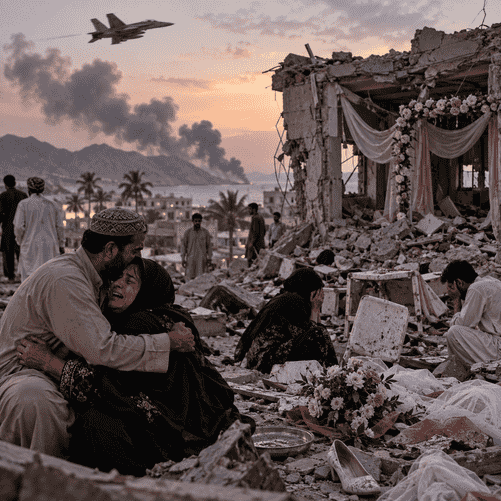
For residents, the destruction was immediate and intimate. Wedding decorations were left scattered among rubble, shoes and personal belongings lay abandoned around the site, and relatives who had arrived expecting music and celebration instead found themselves searching for family members in the wreckage.
The incident has become a focal point in the increasingly bitter debate over civilian casualties in the six-month conflict between Washington and Tehran.
Iran has blamed the United States for the strike. US Central Command has confirmed that American forces were conducting military operations in the area that day, targeting air-defence systems, radar installations, maritime assets and communications infrastructure, but has not said that the wedding itself was deliberately targeted.
A US military review of the incident is now under way. American officials have said the intended target in the area was communications infrastructure, while maintaining that US forces do not intentionally attack civilians.
Evidence examined independently, however, has raised difficult questions about precisely what happened.
A Reuters analysis of verified photographs and video from the site, combined with assessments by weapons specialists, concluded that the explosion was likely caused by a direct strike from a US munition rather than debris or a ricochet from an attack on another target. Experts said the weapon may have been a roughly 500-pound air-delivered guided munition.
The wedding location was approximately 135 metres from a telecommunications tower that was also struck, according to the investigation. That proximity has become central to efforts to understand whether the house was mistakenly identified, whether the weapon deviated from its intended target, or whether intelligence used in the strike was flawed.
For families in Kuhestak, those questions offer little immediate comfort.
The town lies in Hormozgan province near the Strait of Hormuz, one of the world’s most strategically important maritime corridors. Many residents are ethnic Baloch, a community that has long complained of political marginalisation, economic neglect and heavy-handed security policies.
The strike has therefore reopened older grievances.
Local residents and Baloch activists say communities in the region increasingly feel trapped between Iran’s confrontation with foreign powers and Tehran’s own security apparatus. Some have argued that peripheral areas such as Kuhestak are absorbing risks generated by military infrastructure and regional confrontation while receiving relatively little political protection or international attention.
That frustration has sharpened as mourning has turned into anger.
Families who buried relatives this week have questioned why military or communications installations were positioned so close to civilian homes and why ordinary communities are repeatedly exposed to the consequences of strategic confrontation.
Iranian officials have condemned the attack as a war crime and promised a response. Tehran subsequently launched missiles and drones against US-linked military targets across the region as the confrontation intensified.
Washington, meanwhile, insists its latest strikes were directed at military infrastructure associated with Iranian efforts to threaten commercial shipping and US forces around the Strait of Hormuz.
The renewed fighting followed a period of relative calm, but recent exchanges have rapidly restored fears that the conflict could widen again.
The strategic stakes are considerable.
The Strait of Hormuz is a critical route for global oil exports, and renewed military activity has already contributed to higher energy prices and growing concern about commercial shipping. US officials say strikes against Iranian radar, maritime and mine-laying capabilities are intended to protect freedom of navigation and deter attacks on vessels.
But the events in Kuhestak demonstrate how quickly that strategic confrontation can spill into civilian life.
The human consequences are especially visible in places with limited political power.
Baloch communities are spread across southeastern Iran, Pakistan and Afghanistan and have historically faced high levels of poverty and underdevelopment. In Iran, rights organisations have repeatedly documented grievances involving discrimination, security crackdowns and restricted economic opportunities.
The tragedy at the wedding has therefore acquired significance beyond the immediate question of responsibility for the strike.
For some residents, it reinforces the belief that Baloch civilians are being placed dangerously close to a conflict over which they have little control.
The incident also comes against the background of other disputed strikes in southern Iran involving heavy civilian casualties. Earlier in the conflict, a strike on a school compound in Minab killed more than 100 people, according to Iranian authorities and international reporting. The Pentagon opened an investigation into that incident as well.
Such cases are placing increasing pressure on the United States to explain how targets are selected and how civilian-risk assessments are conducted.
Vice President JD Vance said Washington was examining the Kuhestak incident while expressing scepticism toward Iranian accounts of events. He stressed that the United States does not intentionally target civilians and said military mistakes, where they occur, are investigated.
Those assurances are unlikely to resolve the anger in Kuhestak.
The town is still burying its dead, while several of the wounded remain in serious condition.
For the families affected, the central facts are brutally simple: a wedding took place, an explosion struck the gathering and people who had come to celebrate were killed.
The contrast between the scale of the geopolitical confrontation and the intimacy of the loss has given the incident particular emotional force.
A war fought through missiles, radar installations, naval deployments and strategic calculations has reached a family home in a marginalised coastal town.
And in Kuhestak, the question now being asked is not only who fired the weapon, but why communities such as theirs continue to find themselves caught in the path of a conflict decided far beyond them.