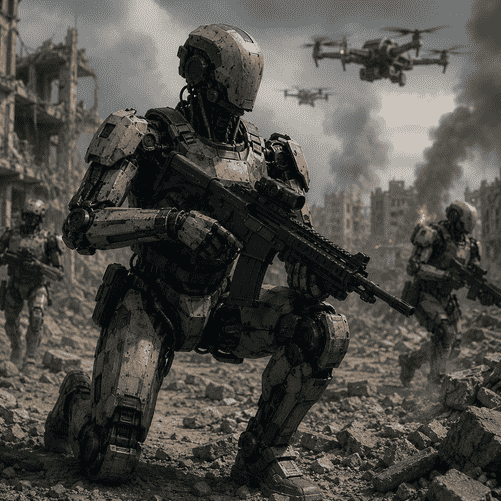
Foundation says its Phantom robot could keep soldiers out of danger, but technical limits and ethical concerns still stand between humanoid machines and real combat roles

Humanoid robots have long belonged to science fiction. Now, one American startup is trying to move them closer to the battlefield.
Foundation, a San Francisco-based robotics company, is developing a humanoid machine called Phantom that it says could eventually support a broad range of defence missions. While many robotics firms are building humanoids for factories, warehouses, homes or companionship, Foundation claims it is the only U.S. company designing them specifically with military applications in mind.
The company’s argument is straightforward: modern war is dangerous, urban, fast-moving and increasingly shaped by unmanned systems. If drones can fly over battlefields, Foundation says, humanoid robots could one day enter buildings, carry supplies, inspect hazardous areas, recover equipment or assist wounded soldiers — reducing the need to expose human troops to ambushes, mines or direct fire.
For now, however, the reality is far more limited than the vision.
Foundation’s current Phantom MK-1 is still at an early stage. Reports say it lacks a built-in battery, cannot yet operate in harsh weather, cannot stand back up by itself after falling and has limited hand strength and dexterity. The company is developing a more advanced MK-2 version that it says will be weather-resistant, able to operate for about six hours on one charge and capable of recovering after a fall.
Those limitations matter because battlefields are among the hardest environments imaginable for robots. Dust, smoke, rain, explosions, uneven terrain, damaged buildings and unpredictable human behavior all create problems that even advanced machines struggle to solve. A robot that performs well in a controlled demonstration may fail quickly in mud, rubble or urban combat.
Still, military interest is growing. Foundation has already received U.S. military-linked research contracts, with reported work involving logistics, manufacturing, inspection and other support functions. The company has also said that two Phantom units have been tested by Ukraine, where the war against Russia has accelerated the use of drones, ground robots and other autonomous systems.
Ukraine has become a testing ground for military robotics. Cheap aerial drones have transformed reconnaissance and attack operations, while ground-based unmanned vehicles are increasingly used for mine clearance, supply transport and evacuation missions. Foundation’s bet is that humanoid robots could be the next step because they are built to operate in spaces designed for people — using stairs, doors, tools, vehicles and equipment without requiring everything around them to be redesigned.
That is also what makes the idea controversial.
Several major robotics companies have publicly opposed weaponizing advanced mobile robots, warning that arming them could create serious risks and damage public trust. Critics fear a future in which machines make life-and-death decisions, blur accountability and lower the political cost of going to war.
Foundation’s executives argue that humans would remain in control of lethal decisions. The company has said the robot’s artificial intelligence would determine how to perform tasks, while military personnel would decide what the robot is allowed to do, including any use of force. That distinction — human control over lethal action — is central to the debate over autonomous weapons.
Yet even with a human in the loop, questions remain. Who is responsible if a robot misidentifies a target? How reliable is remote communication under electronic warfare? Could battlefield pressure lead militaries to grant machines more autonomy over time? And if one country begins deploying armed humanoids, would rivals feel forced to follow?
For now, humanoid robot soldiers remain more concept than combat reality. Experts caution that today’s machines still fall short of human mobility, judgment, endurance and adaptability. A humanoid robot may be useful for carrying supplies or inspecting dangerous spaces long before it becomes capable of fighting beside troops.
But the direction of travel is clear. War is becoming more automated, and defence planners are looking for machines that can reduce casualties, extend reach and operate in places too dangerous for humans. Foundation’s Phantom may not be ready for the front line today, but it signals where parts of the military technology industry believe the battlefield is heading.
The central question is no longer whether robots will play a role in war. They already do. The harder question is whether humanoid robots should become soldiers — and who will decide the limits before the technology catches up with the ambition.