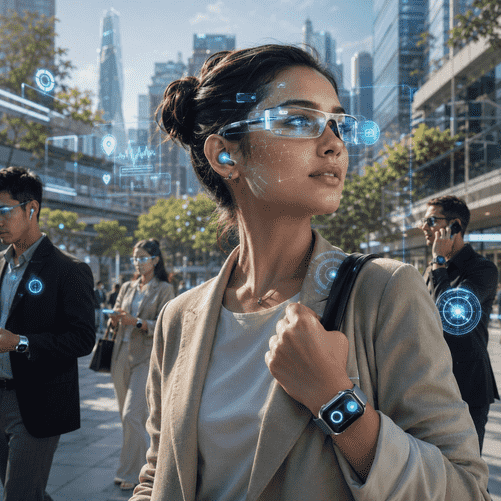
Smart glasses, AI assistants and sensor-powered devices are turning wearables into the next battlefield in personal technology

Wearable AI is moving from the margins of consumer technology to the center of the industry’s next big race. Once associated mainly with fitness trackers, step counters and heart-rate monitors, wearables are now being reimagined as intelligent companions capable of seeing, listening, responding and assisting throughout the day.
The promise is simple but powerful: instead of pulling out a phone, opening an app and typing a request, users could interact with AI through devices already on their bodies. A pair of smart glasses could translate signs in real time, summarize a meeting, identify an object, help navigate a city or record a hands-free video. A smartwatch could become more than a health monitor, acting as a personal assistant that understands patterns, routines and context. Earbuds could evolve into always-available translators and voice agents.
This is why AI wearables are becoming one of the most closely watched battlegrounds in personal tech. The smartphone is still dominant, but it is no longer the only interface companies are designing around. The next stage of computing may be less about screens and more about presence — devices that follow the user through daily life and provide assistance at the exact moment it is needed.
Smart glasses are leading the charge. They offer something smartphones cannot: a first-person view of the world. That makes them especially attractive for artificial intelligence, which depends on context. If a device can see what the user sees, hear what the user hears and understand where the user is, it can offer far more relevant help than a chatbot waiting inside an app.
For technology companies, this creates a new opportunity. The winners of the AI wearable race could control the next major consumer interface, just as Apple reshaped mobile computing with the iPhone. Meta, Google, Apple, Samsung and a growing number of start-ups are all exploring how AI can be integrated into glasses, watches, rings, earbuds and other personal devices.
But the category is still young, and early failures have already shown how difficult it will be. Consumers do not want gadgets that feel awkward, invasive or unnecessary. They want devices that are stylish, comfortable, useful and trustworthy. The collapse of early AI-first products has made one lesson clear: simply attaching artificial intelligence to a device is not enough. The product must solve real problems better than a phone already does.
Privacy is the biggest obstacle. AI wearables often rely on cameras, microphones and sensors, which raises immediate concerns about surveillance, consent and data collection. A smart speaker at home is one thing; a camera-equipped device worn in public is another. Companies will need to convince users — and the people around them — that these products can be safe, transparent and respectful.
Battery life, processing power and connectivity are also major challenges. AI demands significant computing resources, especially when devices are expected to process voice, images and real-world context in real time. Some tasks can happen on the device, while others require cloud processing. That creates technical questions about speed, cost, privacy and reliability.
Still, the direction of travel is clear. AI wearables are attractive because they make technology feel less like a tool and more like an environment. Instead of waiting for commands, future devices may anticipate needs. They could remind users of a person’s name before a meeting, detect stress before it becomes overwhelming, suggest a better route before a delay appears on a map, or help visually impaired users understand their surroundings.
The health sector may be one of the biggest beneficiaries. Wearables already collect data on heart rate, sleep, movement and exercise. With AI, that information could become more predictive and personalized. Devices could detect subtle changes in behavior, flag potential health risks, or provide coaching based on long-term patterns rather than isolated metrics.
Work is another major frontier. AI glasses and earbuds could support technicians, doctors, warehouse employees, journalists, students and office workers by offering real-time information while their hands remain free. In professional environments, the most valuable AI wearable may not be the flashiest one, but the one that quietly saves time.
The rise of wearable AI also reflects a broader shift in technology: the move from apps to agents. Instead of users managing dozens of separate tools, AI assistants may coordinate tasks across services. A wearable device could become the physical gateway to that agent, giving it eyes, ears and constant proximity.
Yet the future is not guaranteed. The industry must avoid repeating the mistakes of earlier wearable experiments that were overhyped, expensive or socially uncomfortable. The most successful AI wearables will likely be those that blend into everyday life rather than demanding attention. Design may matter as much as intelligence.
What makes this moment different is that the technology is finally catching up with the idea. Multimodal AI can interpret speech, images and context. Chips are becoming smaller and more efficient. Consumers are becoming more familiar with AI assistants. At the same time, major companies are searching for the next platform beyond the smartphone.
That combination explains why wearable AI is no longer a niche category. It is becoming the next frontier of personal computing — a contest over who will own the interface between artificial intelligence and daily life.
The device that wins may not look like a phone. It may sit on your face, rest in your ear, wrap around your wrist or disappear into something you already wear. But if the industry gets it right, the next big thing in personal technology will not just be in your pocket. It will be on you.