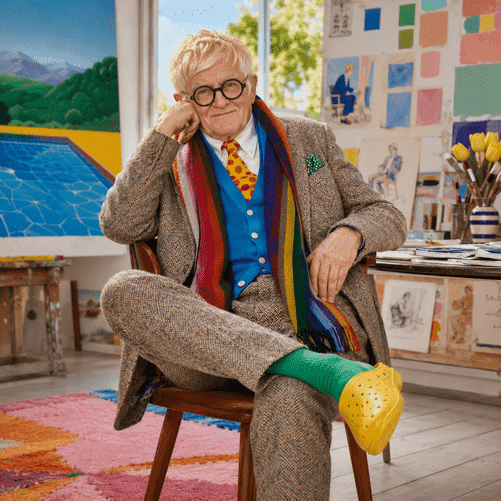
From peroxide-blond hair and heavy spectacles to rumpled tweed, mismatched knits and bright yellow Crocs, the British artist turned personal style into another form of creative expression

David Hockney never needed a runway to become a fashion icon.
Long before artists were expected to cultivate carefully managed public images, Hockney had created one almost instinctively. His peroxide-blond hair, thick round glasses and unruly combinations of colour made him instantly recognisable—not only as one of Britain’s greatest artists, but as a man who appeared to carry the energy of his paintings directly into his wardrobe.
Across more than six decades, his clothes evolved without ever losing their central character. There were sharply cut suits in the 1960s, striped rugby shirts and relaxed American sportswear, softly crumpled tweed, bright cardigans, patterned ties, oversized scarves and, in later years, vividly coloured Crocs.
The result was not conventional elegance. It was something more memorable: a personal uniform shaped by curiosity, humour and complete indifference to the rules of coordinated dressing.
Hockney’s style endured because it never looked assembled by a committee. His outfits appeared spontaneous, practical and slightly chaotic. Yet, like the compositions in his paintings, the apparent disorder was held together by a remarkably confident eye.
The Blond Hair That Became a Signature
Hockney’s transformation into a visual icon began while he was still a young artist.
Born in Bradford in 1937, he arrived at London’s Royal College of Art at the end of the 1950s and quickly distinguished himself from the more restrained figures around him. At a time when young British men were generally expected to conform to narrow standards of appearance, Hockney dyed his hair an artificial, attention-grabbing blond.
The colour was deliberately unnatural. It framed his face, contrasted dramatically with his dark spectacles and ensured that he stood out in photographs.
His glasses became equally important. Thick, circular and almost cartoonish, they were functional objects transformed into graphic symbols. Together, the pale hair and dark frames gave Hockney the appearance of someone who had drawn himself using a few decisive lines.
The look was playful, but it was also a form of self-invention.
For a working-class young man entering the London art world, clothes offered a way to reject the identity others might have assigned to him. His style announced freedom, modernity and a refusal to disappear into the background.
It also made his image unusually reproducible. Hockney could be recognised immediately in a crowded photograph, a quality that helped turn him into one of the defining cultural personalities of the 1960s.
Dressing in the Colours of His Work
Colour was the most obvious connection between Hockney’s art and his clothes.
His paintings became famous for brilliant swimming-pool blues, sharp greens, warm pinks, sunlit yellows and clean expanses of California light. His wardrobe followed a similar logic, though often with less apparent discipline.
He combined red scarves with yellow ties, blue shirts with green knitwear and patterned trousers with jackets that seemed to belong to entirely different outfits. Socks might not match. A vivid accessory could be placed against muted tailoring. Several prints could appear at once.
The effect was rarely polished in the traditional sense. His clothes were often creased, slightly oversized or worn with the relaxed posture of someone who had more important matters to consider.
Yet the colours seldom seemed timid or accidental.
Hockney understood that colour could produce emotion before it conveyed meaning. A scarlet tie, lime sweater or pair of yellow glasses could lift an otherwise ordinary outfit, just as a bright patch of paint could transform the balance of a canvas.
He dressed with the freedom of someone who trusted his eye more than accepted ideas of taste.
The Artist in Tweed
For all his association with California modernism, Hockney remained unmistakably English.
Tweed became one of the recurring materials in his wardrobe, particularly as he grew older. He wore checked jackets, soft brown suits, flat caps and woollen layers that evoked Yorkshire professors, country painters and eccentric members of old artistic clubs.
But Hockney rarely wore tweed conventionally.
A traditional jacket might be combined with a striped shirt, spotted tie, bright cardigan or clashing scarf. A suit could be slightly rumpled, its pockets filled, its formality undermined by comfortable shoes or the presence of a cigarette.
He made respectable British clothing look mischievous.
The contrast captured something essential about his identity. Hockney was both an establishment figure and a lifelong outsider: a member of the Order of Merit who had declined a knighthood, a celebrated national artist who remained suspicious of solemnity and authority.
His tweed acknowledged tradition without surrendering to it.
Clothes Made for Working
Hockney’s style was not designed only for public appearances. Many of his most memorable outfits were worn while painting, drawing or moving around his studio.
Suits became marked with pigment. Shirt cuffs were rolled. Jackets softened with use. Scarves hung loose rather than being arranged with precision.
This working quality distinguished him from celebrities whose eccentricity existed primarily for cameras. Hockney’s wardrobe looked lived in because it was.
He might attend an exhibition opening in clothing that seemed to have come directly from the studio. The paint marks and creases strengthened rather than weakened the impression that his clothes belonged to him.
Fashion often celebrates immaculate surfaces. Hockney’s appearance suggested that wear, comfort and personality were more interesting.
A jacket was not ruined because paint had reached it. It had acquired a record of its owner’s life.
From Rugby Shirts to Cardigans
Not every Hockney outfit depended on tailoring.
During his years in the United States, he adopted elements of relaxed American dress: polo shirts, rugby tops, baseball caps, sweatshirts, chinos and casual shoes.
These garments suited both the Los Angeles climate and the new visual world he was exploring. Stripes became particularly prominent, echoing the clean lines and geometric rhythms found in his paintings, stage designs and photographic collages.
In later life, cardigans and sweater vests became central to his appearance. They offered warmth and practicality but also created new opportunities for colour.
A bright knit could be placed beneath a dark jacket. A green cardigan might be combined with a red tie. A patterned sweater could sit beside another pattern without apology.
The clothes became softer as he aged, but the palette remained energetic.
Hockney did not retreat into neutral colours or conservative understatement. His later wardrobe continued to communicate delight in visual experience.
The Famous Yellow Crocs
Few moments captured Hockney’s attitude toward fashion more perfectly than his appearance at Buckingham Palace in 2022.
Invited to attend a formal event hosted by King Charles, the artist arrived in a checked suit, bright accessories and a pair of vivid yellow Crocs.
The shoes were practical, comfortable and entirely unsuitable according to traditional standards of royal dressing—which made them completely appropriate for Hockney.
When the King remarked on their colour, Hockney reportedly replied that he had chosen them himself.
The exchange was humorous, but the image became instantly memorable. Here was one of Britain’s most honoured artists entering the palace without disguising himself as anyone else.
The Crocs did not diminish the suit. They completed the portrait.
Hockney understood that genuine style does not always mean selecting the most expensive or conventionally refined object. It can mean choosing the thing that gives pleasure and wearing it with enough conviction that the rules become irrelevant.
Fashion’s Enduring Fascination
Designers repeatedly returned to Hockney’s wardrobe for inspiration.
His combination of English tailoring, art-school irreverence and saturated colour influenced collections by designers including Paul Smith and Christopher Bailey, whose work at Burberry frequently explored the same tension between British tradition and youthful eccentricity.
Hockney’s influence can also be seen in the wider revival of brightly coloured menswear, statement spectacles, patterned knitwear and relaxed tailoring.
Musicians, filmmakers and younger artists have borrowed elements of his appearance, whether consciously or not. Harry Styles’ affection for bold knitwear and unconventional colour combinations, Wes Anderson’s carefully constructed palettes and Tyler, the Creator’s playful preppy clothing all occupy cultural territory that Hockney helped make possible.
He demonstrated that masculine style did not need to depend on severity, restraint or dark colours.
A man could wear pink, yellow, green and mauve without treating them as jokes. He could be intellectual without dressing drably, successful without appearing corporate and elderly without becoming visually invisible.
Style Without a Stylist
What makes Hockney’s wardrobe feel particularly compelling today is its distance from contemporary celebrity styling.
Modern public figures often appear in outfits selected for them, coordinated with brands and calculated for social-media circulation. Even apparent eccentricity can be carefully planned.
Hockney’s clothes rarely produced that impression.
His style developed gradually, through repetition and personal attachment. The glasses remained because he liked them. The cardigans, caps, ties and comfortable shoes became familiar because they suited his life.
There was continuity without rigidity.
He altered the proportions, materials and combinations over time, but the underlying principles remained constant: colour should give pleasure, clothes should be useful and individuality should never be sacrificed for respectability.
That authenticity made him difficult to imitate fully. A designer could reproduce the tweed, the yellow frames or the clashing knitwear, but the essential ingredient was Hockney’s lack of self-consciousness.
He did not appear to be performing eccentricity. He simply had no interest in pretending to be conventional.
The Body as Another Canvas
Hockney spent his career asking people to look more carefully.
He questioned fixed perspective, explored how photographs construct space and argued that seeing is an active, creative process. His clothing extended the same invitation.
A suit was not merely brown; it was a field of checks capable of interacting with a striped shirt. Glasses were not just medical devices; they were circles framing the eyes. A scarf created a line, a cardigan introduced a block of colour and a bright shoe disrupted the composition below.
In this sense, Hockney treated the dressed body as another visual arrangement.
That does not mean every outfit was consciously designed as an artwork. Its power came partly from the opposite: he applied an artist’s instincts without appearing to labour over the result.
He knew that unexpected combinations could create energy. He understood that proportion mattered less than personality and that beauty was not the same as neatness.
His clothes, like his paintings, encouraged attention.
A Legacy Beyond the Gallery
David Hockney’s artistic legacy rests on paintings, portraits, landscapes, photographic experiments, stage designs and digital works that changed how generations understood colour and perception.
His fashion legacy is less monumental, but it remains deeply influential.
He showed that personal style can be developed rather than purchased. It can become richer with age rather than more cautious. It can draw from tradition while refusing obedience to it.
Most importantly, he demonstrated that fashion could be joyful without becoming superficial.
The peroxide hair faded. The sharp suits softened into cardigans and tweed. Brogues gave way to Crocs. Yet the central idea remained intact from youth to old age: the world contains more colour than convention permits, and there is no good reason not to wear it.
Hockney dressed exactly as he painted—with curiosity, independence and the conviction that seeing something differently could make life more vivid.