Michel Kuka Mboladinga never kicks the ball or enters the pitch, yet his silent tribute to Patrice Lumumba has made him one of DR Congo’s most influential figures at the tournament

Michel Kuka Mboladinga does not sing, dance or wave a flag when the Democratic Republic of the Congo plays football.
He stands still.
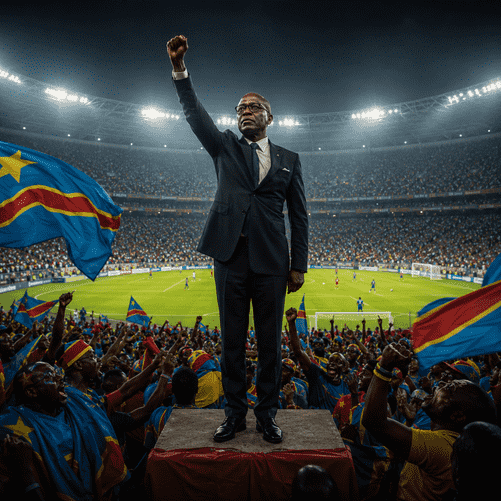
For almost the entire match, the 53-year-old supporter raises one arm and fixes his eyes on the pitch, maintaining a motionless pose while thousands of spectators around him jump, shout and celebrate.
The ritual has transformed Mboladinga from an ordinary supporter into one of African football’s most recognisable figures. To many Congolese fans and players, his silent presence has become so closely associated with the national team’s fortunes that travelling without him appears almost unthinkable.
Some supporters jokingly—or sincerely—credit him with stopping opposition goals. Players regard him as a source of strength. Government officials now treat him as part of the national football story.
His influence became unmistakable before the 2026 World Cup, when travel restrictions and visa complications threatened to prevent him from reaching the United States. The issue eventually drew the attention of President Félix Tshisekedi, who helped ensure that Mboladinga was included in DR Congo’s official delegation.
It was an extraordinary level of intervention for a man whose role consists entirely of standing in the crowd.
A tribute that became a national phenomenon
Mboladinga’s pose is not simply a superstition or an unusual form of celebration.
It is a tribute to Patrice Lumumba, the Democratic Republic of the Congo’s first prime minister and one of the most important figures in the history of African independence.
Lumumba helped lead the country out of Belgian colonial rule in 1960. He was overthrown and assassinated the following year, becoming an enduring symbol of anti-colonial resistance, national sovereignty and the political struggles that followed independence.
Mboladinga deliberately resembles him.
Wearing a suit, glasses and carefully chosen accessories, he takes his position on a pedestal in the stands and imitates the raised-arm pose of a prominent Lumumba memorial in Kinshasa.
The performance earned him the nickname “Lumumba Vea,” commonly translated as “Lumumba Lives.”
During the 2025 Africa Cup of Nations in Morocco, television cameras repeatedly returned to the motionless figure amid the chaos of the crowd. Videos spread rapidly across social media, introducing him to audiences far beyond Congo.
What initially appeared eccentric soon acquired deeper meaning.
For Congolese supporters, the image brought together football, history and national identity. The stillness represented discipline and resilience. The resemblance to Lumumba transformed a stadium performance into a public act of remembrance.
The belief that he can influence matches
Football supporters everywhere develop rituals.
Some wear the same shirt for every match. Others refuse to watch penalties, sit in particular seats or repeat chants believed to bring good fortune.
Mboladinga’s ritual is more theatrical, but it belongs to the same emotional world.
He has said he believes his concentration can help protect the team and prevent opponents from scoring. His motionless posture is presented as an act of mental force directed toward the pitch.
There is, of course, no sporting evidence that a supporter can physically influence the flight of a ball. Yet football has never operated entirely within the boundaries of reason.
Players speak of momentum, energy and the psychological effect of a crowd. Coaches recognise that belief can alter performance even when its source is symbolic.
For DR Congo, Mboladinga has become a visible expression of that belief.
The longer he remains still, the more supporters invest meaning in the performance. Every save strengthens the legend. Every victory reinforces the idea that the human statue belongs beside the team.
His importance is therefore not measured by whether he literally stops goals. It lies in his ability to make players and supporters feel that someone is holding the line for them.
Mboladinga’s transformation into a national celebrity has been remarkably rapid.
His appearances have attracted crowds, commercial sponsorships and official recognition. Supporters surround him after matches, while fellow fans sometimes form protective barriers to help him move through stadiums and public spaces.
The national team has embraced him as well.
Players reportedly wanted him present during their World Cup campaign, regarding his ritual as part of the atmosphere surrounding the squad.
That request carried unusual political weight because DR Congo’s journey to North America was already complicated by health and immigration restrictions connected to an Ebola outbreak.
The United States imposed entry controls on people who had recently travelled through affected countries. Although special arrangements were developed for the football team, those protections did not automatically extend to ordinary supporters.
Mboladinga consequently faced the possibility that the national side would reach its first World Cup in more than half a century without the fan who had become its unofficial guardian.
President Tshisekedi’s intervention elevated the matter beyond sport.
By placing Mboladinga within the official delegation, the government effectively recognised that his presence possessed national and diplomatic significance.
A fan had become part of the state’s representation abroad.
Even presidential support could not eliminate every logistical obstacle.
Travel restrictions, documentation requirements and delays prevented Mboladinga from reaching the United States in time for DR Congo’s opening World Cup fixture against Portugal in Houston.
His absence was conspicuous precisely because his stillness had become so familiar.
A supporter who does almost nothing during a match had created a visible emptiness by not being there.
Officials expected him to join the delegation later, potentially appearing when DR Congo played Uzbekistan in Atlanta.
The journey illustrates the complicated reality surrounding the first World Cup staged across the United States, Canada and Mexico.
The tournament presents itself as a global celebration, yet visa decisions, health rules and border controls have prevented some players, officials and supporters from moving freely between host countries.
For nations with limited diplomatic influence, entry into the stadium can depend on negotiations extending far beyond football.
Mboladinga’s experience has therefore become part of a wider debate about who is able to participate in a supposedly universal sporting event.
Congo returns after 52 years
DR Congo’s presence at the tournament carries enormous historical weight.
The country had not appeared at a men’s World Cup since 1974, when it competed under the name Zaire. That campaign ended in three defeats and became remembered internationally for moments of confusion and sporting humiliation.
The history behind that team was far more complicated than the images suggested.
The players competed under the dictatorship of Mobutu Sese Seko and faced intense political pressure. Their World Cup experience became entangled with propaganda, unpaid bonuses and threats from the regime.
More than five decades later, the current team arrives with an opportunity to create a different national memory.
Its players represent clubs across Europe and Africa, while the country’s diaspora has expanded the team’s following far beyond Congolese borders.
Mboladinga’s presence connects that modern squad to an older history—not the authoritarian symbolism of the Zaire era, but the independence struggle associated with Lumumba.
His performance suggests that DR Congo’s return is not only about correcting a football record. It is also about deciding which national figures and memories the country wishes to carry onto the world stage.
Contemporary football culture is designed for constant motion.
Supporters film themselves, produce online commentary and compete for viral attention. Stadium screens encourage noise, while sponsorship campaigns turn fan behaviour into branded entertainment.
Mboladinga attracts attention by rejecting all of it.
His power lies in restraint. He does not chase the camera. The camera is drawn to him because he refuses to react.
That stillness makes him ideally suited to the visual logic of social media. Surrounded by thousands of moving bodies, he is instantly recognisable in a photograph or short video.
Yet the image works because it communicates more than novelty.
His pose resembles a monument brought to life. It turns the football stand into a public square and the match into an occasion for historical remembrance.
In that sense, Mboladinga is simultaneously a supporter, performer and political symbol.
The international popularity of “Lumumba Vea” has also introduced younger football audiences to the man he represents.
Patrice Lumumba remains a powerful figure across Africa, where his assassination is widely viewed as an example of the violence and foreign interference that accompanied decolonisation.
Belgium formally acknowledged responsibility for aspects of the circumstances surrounding his death, while the involvement of Cold War powers remains an important part of historical debate.
Within Congo, Lumumba’s image has been used by politicians across different generations, sometimes sincerely and sometimes opportunistically.
Mboladinga’s tribute is more personal.
Rather than delivering speeches about independence, he recreates a familiar national image and allows supporters to assign their own meaning to it.
Some see resistance. Others see dignity, unity or the survival of a country that has endured dictatorship, war and political instability.
Football provides the stage, but the emotion reaches far beyond sport.
The attention surrounding Mboladinga also raises a difficult question.
When a supporter becomes associated with victories, expectations can turn into pressure. A defeat may lead some fans to question whether he changed his ritual, lost concentration or arrived too late.
Superstition can be harmless, but it can also burden the person chosen as its symbol.
Mboladinga must remain motionless for long periods in crowded stadiums, often under intense heat and scrutiny. His performance is demanding even though it appears effortless.
Commercial opportunities and political attention may also change how supporters interpret him. An authentic grassroots figure can quickly become incorporated into official campaigns or brand promotions.
His popularity will depend partly on whether fans continue to view him as one of their own rather than as a manufactured mascot.
For now, the affection appears genuine.
He emerged from the stands rather than from a marketing department, and his ritual gained meaning before institutions attempted to claim it.
Whether DR Congo advances at the World Cup will ultimately depend on its players, tactics and ability to compete against stronger and wealthier football nations.
Mboladinga cannot make a save, complete a pass or score a decisive goal.
But sport is shaped by more than the actions recorded in official statistics.
National teams carry stories, memories and symbols. Supporters create the emotional environment in which players perform. Certain figures come to embody the hopes of millions precisely because they stand outside the professional machinery of the game.
Mboladinga has become such a figure.
His motionless salute captures the contradiction of Congolese football: a nation moving forward while remaining closely connected to an unresolved past.
In a tournament dominated by global stars, enormous stadiums and billion-dollar commercial deals, one of DR Congo’s most valuable figures is a silent man in the crowd.
He says he can stop goals.
What he has unquestionably done is make the world stop and look.