The Avondvierdaagse brings children, parents and teachers into the streets for four nights of walking, friendship and shared achievement—offering a revealing glimpse into why Dutch childhood consistently scores so highly for wellbeing.

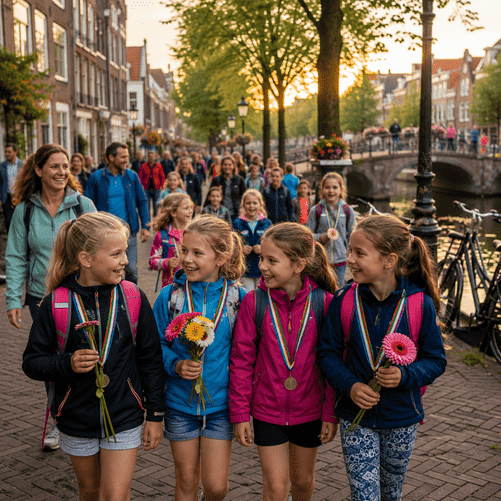
As the afternoon fades across towns and cities in the Netherlands, an unusual procession begins to form. Children arrive in raincoats and trainers, accompanied by parents, teachers and volunteers. Some carry snacks, others wear matching school shirts, and almost all are prepared to walk several kilometres before returning home.
This is the Avondvierdaagse, or “four-day evening walk”, one of the Netherlands’ most distinctive childhood traditions. Held annually in communities across the country, it asks participants to complete a walking route on four evenings during the same week, usually covering five or 10 kilometres each night.
There are no winners, finishing times or elite athletes. The reward comes from completing the challenge together.
At the end of the fourth walk, children are often welcomed with flowers, sweets and medals. Streets become crowded with relatives and neighbours celebrating their arrival, transforming an ordinary week of exercise into something closer to a local festival.
The event may appear simple, but its appeal lies precisely in that simplicity. Children move, talk, explore their neighbourhoods and spend time with friends away from classrooms and screens. Parents walk beside them, volunteers direct routes, and local businesses frequently contribute refreshments or decorations.
It is physical activity without the pressure of competitive sport and community life without the expense or formality of a major organised attraction.
The Avondvierdaagse has its roots in the Netherlands’ long tradition of multi-day walking. The country’s famous Nijmegen marches began as a military exercise in the early 20th century before developing into a large civilian event. Smaller evening walks later emerged around the country and became especially popular among primary-school children and their families.
Today, hundreds of local versions are organised in villages, suburbs and major cities. Participants follow routes through parks, residential streets and nearby countryside, often continuing despite wind or rain.
For children, walking four nights in succession can feel like a serious test. Five kilometres may be manageable on the first evening, but tired legs and poor weather make the later stages more demanding.
That difficulty is part of the attraction. Completing the event can give young participants a clear sense of achievement. They learn that discomfort can be temporary, that effort becomes easier when shared and that a large goal can be reached through a series of smaller steps.
The emotional experience may be as important as the exercise itself. Physical activity is more likely to become a lasting habit when children associate it with enjoyment, friendship and recognition rather than obligation.
The Avondvierdaagse creates exactly that association. Walking is not presented as punishment for inactivity or as a lesson about health. It becomes a celebration, accompanied by conversation, music, familiar faces and the anticipation of a medal at the finish.
The tradition also creates a rare form of intergenerational contact. Parents who might otherwise watch their children from the edge of a sports field take part directly. Teachers meet families outside school. Older residents volunteer as route marshals, while local shops and organisations help provide supplies.
These repeated interactions strengthen relationships that are often weakened in more isolated or heavily scheduled communities.
Dutch children regularly perform exceptionally well in international assessments of life satisfaction and overall wellbeing. No single custom can explain that success. The country also benefits from comparatively safe streets, extensive cycling infrastructure, strong peer relationships and a culture that often grants children greater independence than in many other wealthy societies.
Many Dutch parents work part-time, creating more opportunities for family contact. Children commonly cycle to school, visit friends independently and spend considerable time outdoors.
The Avondvierdaagse fits naturally into that wider system. It does not manufacture wellbeing over four evenings; rather, it concentrates many of the qualities already associated with Dutch childhood into one highly visible event.
There is movement without intense competition, freedom within a safe structure and social contact across age groups. Children experience their neighbourhood not merely as a collection of roads and buildings, but as a place filled with people who recognise and support them.
That sense of belonging may be particularly valuable at a time when children in many countries are becoming more sedentary and socially isolated. Digital entertainment increasingly occupies leisure time, while parental concerns about traffic and safety can limit independent outdoor activity.
A supervised community walk offers a compromise. Children can explore beyond their immediate homes while remaining part of a trusted group. The route feels adventurous without becoming unsafe, and the collective structure reassures parents who might be reluctant to let children roam alone.
The festival is not without limitations. Its success depends heavily on unpaid organisers, and some communities have struggled to find enough volunteers to run four consecutive evenings.
Participation may also be easier for families with flexible working hours. Parents employed during evenings, people with disabilities and households unable to manage registration costs or transport can face barriers, even when organisers attempt to make the walks inclusive.
There is also a danger in romanticising Dutch childhood. High national wellbeing rankings cannot erase individual hardship, inequality, school pressure or mental-health difficulties. Not every child experiences the freedom and security represented by the Avondvierdaagse.
Nevertheless, the event offers a useful lesson. Programmes supporting children do not always require sophisticated technology, specialist facilities or large institutional budgets.
Sometimes the most effective ideas are those that combine ordinary activities in an unusually thoughtful way.
Walking becomes more appealing when it is social. Exercise becomes more meaningful when it has a visible conclusion. Neighbourhoods become safer and friendlier when residents occupy their streets together. Children become more confident when adults offer support without taking over the experience.
The Dutch have a word often associated with occasions of this kind: “gezelligheid”. It can suggest warmth, companionship, comfort and the pleasure of being together, although no single English translation captures it completely.
That quality is present throughout the Avondvierdaagse. It appears in the groups sheltering together beneath umbrellas, in parents carrying water bottles, in children encouraging tired classmates and in the crowds waiting at the final line.
The festival alone cannot explain why Dutch children are among the world’s happiest and healthiest. But it reveals something important about the society around them.
Wellbeing is not treated only as an individual responsibility. It is built collectively—in schools, families, streets and shared traditions.
For four evenings each year, the Avondvierdaagse turns that principle into a public procession. Children walk through the places where they live, supported by the people who share them, discovering that health, resilience and friendship can all begin with the same simple act: stepping outside together.