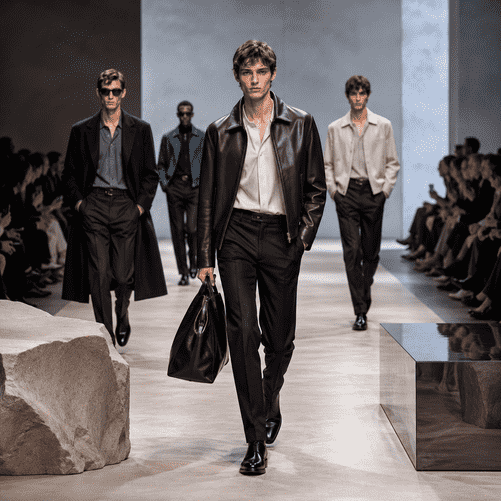
At Milan Fashion Week, Miuccia Prada and Raf Simons presented a stripped-back menswear collection that reflects a wider shift in luxury: less spectacle, more permanence.

In a luxury market crowded by logos, viral moments and constant reinvention, Prada is making a quieter argument: the future of high fashion may lie in restraint.
At Milan Fashion Week, Miuccia Prada and Raf Simons unveiled a menswear collection built around simplicity, clarity and everyday function. The show rejected excess in favour of clean silhouettes, reduced decoration and familiar wardrobe staples reworked with precision. Jeans, jackets, blazers, slim trousers and T-shirts formed the foundation of the collection, but they were elevated through refined materials, sharp proportions and subtle construction details.
The message was deliberate. Prada and Simons appear to be responding to a luxury consumer who is increasingly skeptical of novelty for novelty’s sake. After years of maximalist branding, fast-moving trends and digital spectacle, many shoppers are looking for clothes that feel durable, intelligent and less dependent on seasonal hype.
The collection, titled “Clarity,” presented a vision of luxury rooted in usefulness rather than display. Cropped leather jackets, slim five-pocket trousers, translucent shirt-jackets and restrained knitwear suggested a wardrobe designed for longevity. Even when colour appeared — in burgundy, turquoise, antique white and grey — it was controlled rather than loud.
This shift matters beyond Prada. Across the global luxury sector, brands are being forced to defend their value at a time when aspirational consumers are more cautious, prices have risen sharply, and the industry’s growth outlook has weakened. In that context, simplicity can become a business strategy as much as an aesthetic choice.
For Prada, minimalism is not new. The brand has long built its identity on intellectual restraint, functional beauty and a tension between the ordinary and the luxurious. But this latest collection gives that heritage renewed relevance. It suggests that fashion’s next status symbol may not be obvious wealth, but discernment — the ability to recognize quality without needing it to shout.
The show also points to a broader trend in style: a return to clothes that can move from runway to street without losing meaning. Instead of fantasy dressing, Prada offered a wardrobe that seemed intentionally close to real life. That decision reflects a growing desire for fashion that feels wearable, adaptable and emotionally grounded.
Still, restraint is not risk-free. In a market driven by social media visibility, quiet clothes can be harder to turn into viral images. Luxury brands must balance subtlety with recognition, especially when younger consumers often discover fashion through screens. Prada’s answer appears to be precision: make the ordinary strange enough, elegant enough and desirable enough to command attention without relying on spectacle.
The result is a collection that feels less like a seasonal reset and more like a statement about where luxury may be heading. As consumers question prices, authenticity and purpose, brands are being pushed to offer more than surface-level desire.
Prada’s latest message is clear: in uncertain times, luxury may need fewer distractions — and better clothes.