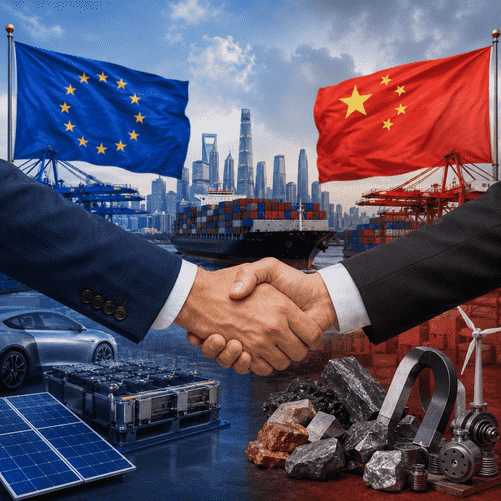
Brussels is preparing for high-level talks with Beijing as Europe seeks to protect critical industries, reduce supply vulnerabilities and respond to a widening trade imbalance.

Europe’s economic relationship with China is entering a more difficult phase, as Brussels prepares for new trade talks aimed at addressing a widening imbalance and growing concerns over strategic dependence.
Chinese Commerce Minister Wang Wentao is expected to meet European Trade Commissioner Maroš Šefčovič in Brussels, in a discussion likely to focus on market access, industrial competition and Europe’s exposure to critical supply chains. The meeting comes at a time when European policymakers are under increasing pressure to defend domestic industries while avoiding a damaging trade confrontation with Beijing.
At the center of the dispute is Europe’s growing trade deficit with China. Chinese exports to the European Union have continued to expand, while European companies complain that access to the Chinese market remains uneven and politically constrained. For many EU governments, the imbalance is no longer only an economic issue. It has become a question of industrial security.
The concern is especially sharp in sectors such as electric vehicles, batteries, solar panels, machinery and critical minerals. European manufacturers say they are competing against Chinese companies that benefit from state support, cheaper production costs and dominant supply chains. The result is a growing fear that Europe could lose key industrial capacity just as the global economy becomes more dependent on clean technology and advanced manufacturing.
Rare earths have added urgency to the debate. China’s export restrictions on some critical minerals have alarmed European companies that rely on these materials for electronics, defense systems, renewable energy equipment and electric vehicles. The restrictions have reinforced a lesson already learned during the pandemic and the energy crisis: economic dependence can quickly become a strategic vulnerability.
Brussels is now considering measures that would force or encourage European companies to diversify their sources of critical supplies. The goal is not to cut trade with China entirely, but to reduce the risk that a single country can disrupt essential industries. This approach reflects a broader European strategy known as “de-risking” — maintaining commercial ties while limiting exposure in sensitive areas.
The challenge is that Europe’s economy remains deeply connected to China. German carmakers, luxury brands, industrial suppliers and technology firms all depend on Chinese demand. At the same time, European consumers benefit from lower-cost Chinese goods. Any aggressive trade response could therefore carry real costs for European businesses and households.
China, for its part, has warned against protectionism and argues that its companies are competitive because of efficiency, scale and innovation. Beijing is likely to resist EU pressure while trying to preserve access to one of its most important export markets.
The Brussels meeting will therefore test whether both sides can manage their differences without triggering a broader trade conflict. Europe wants fairer competition and more secure supply chains. China wants to protect its export-driven growth model and resist restrictions on its industrial champions.
For the European Union, the stakes are high. If it moves too slowly, it risks deeper dependence and further pressure on domestic industry. If it moves too aggressively, it could provoke retaliation and harm companies that rely on China.
The latest talks are unlikely to solve the dispute immediately. But they mark another step in Europe’s attempt to redefine its economic relationship with Beijing. Trade with China is no longer treated simply as a source of growth. It is now viewed through the lens of security, resilience and political power.
That shift may shape Europe’s economic policy for years to come.