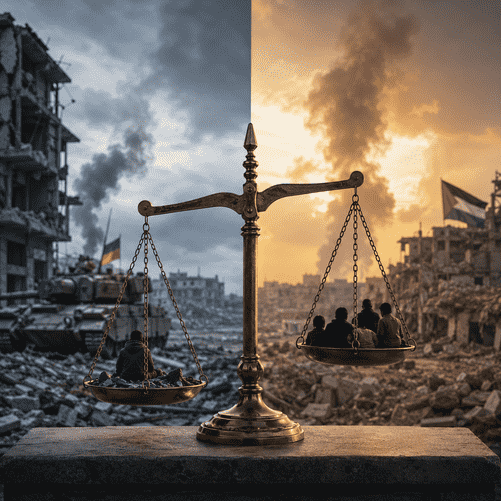
Rome says the European Union risks weakening its credibility by condemning some military aggressions forcefully while responding more cautiously to others.

The Vatican has sharpened its criticism of the European Union’s approach to war, accusing European leaders of applying international law selectively and warning that such double standards risk damaging the credibility of the rules-based order.
The criticism reflects growing unease in Rome over the way Western governments respond differently to conflicts depending on political alliances, strategic interests and regional priorities. Vatican officials have pointed to Europe’s strong sanctions regime against Russia following its invasion of Ukraine, while arguing that comparable moral and legal clarity has not always been applied to other wars, including the devastation in Gaza.
At the center of the Vatican’s concern is the principle of consistency. For the Holy See, international law cannot function as a flexible instrument used only when it serves political convenience. If invasions, attacks on civilians and violations of humanitarian law are condemned in one conflict but treated more cautiously in another, the moral force of international law is weakened.
The argument is especially sensitive for the European Union, which presents itself as a defender of human rights, sovereignty and multilateral rules. Since Russia’s full-scale invasion of Ukraine, the EU has imposed sweeping sanctions, supported Kyiv politically and financially, and pushed for accountability over alleged war crimes. Brussels has framed that response as a defense not only of Ukraine, but of the international order itself.
The Vatican is not disputing the gravity of Russia’s aggression. Instead, its criticism focuses on whether Europe applies the same standards to allies and partners when they are accused of violating international law. Rome’s message is that the law must protect civilians everywhere, not only in conflicts where Europe finds political consensus easier to achieve.
This places the EU in a difficult position. Member states remain divided over how far to go in criticizing Israel, how to respond to the war in Gaza, and how to balance humanitarian pressure with diplomatic, security and historical considerations. Some European governments have called for stronger measures, while others have resisted sanctions or tougher political action.
The Vatican’s intervention adds moral pressure to that debate. The Holy See has repeatedly called for ceasefires, humanitarian access and renewed diplomacy in conflicts from Ukraine to the Middle East. Its position is rooted in a broader rejection of the idea that peace can be secured primarily through military strength.
For Rome, the danger is not only the continuation of war. It is the normalization of a world in which powerful states decide when international rules matter and when they can be ignored. That, Vatican officials argue, replaces the force of law with the law of force.
The EU has defended its record by insisting that it remains committed to international law, the United Nations Charter and the protection of civilians. European leaders have also argued that different conflicts require different diplomatic tools. But critics say that explanation does not erase the perception that Europe moves decisively against adversaries while hesitating when partners or allies are involved.
The debate comes at a moment when Europe is trying to define its role in a more unstable world. Wars in Ukraine, Gaza and the wider Middle East have exposed the limits of EU unity and the difficulty of turning moral principles into common foreign policy.
The Vatican’s accusation therefore strikes at a central question for Brussels: can the European Union remain credible as a global defender of law if its response to violations appears inconsistent?
For the Holy See, the answer depends on whether Europe can recover a universal standard. Peace, Rome argues, cannot be built on selective outrage. It requires the same concern for civilian life, sovereignty and human dignity wherever war takes place.
That message is unlikely to resolve Europe’s foreign-policy divisions. But it has forced a sharper conversation about the gap between Europe’s values and its actions — and about whether international law can survive if it is enforced only when politically convenient.