The Federal Reserve chair says inflation risks have eased, but his refusal to signal whether officials should raise interest rates leaves investors facing a more opaque and potentially volatile policy era.

Federal Reserve Chair Kevin Warsh has acknowledged that the inflation outlook has improved, but declined to say whether the U.S. central bank should raise interest rates at its next meeting, setting up a tense policy debate that could test his early leadership of the institution.
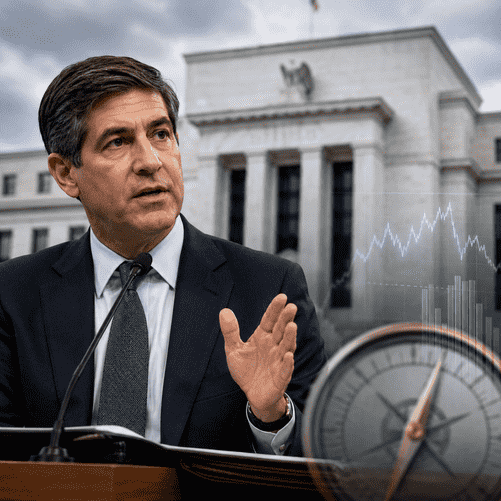
Speaking at a European Central Bank conference in Sintra, Portugal, Warsh said inflation risks had diminished in recent weeks, helped in part by lower energy prices and calmer financial conditions. But he also stressed that inflation remains above the Fed’s 2% target and that the central bank cannot become complacent.
The remarks were closely watched because Warsh has only recently taken over as Fed chair and is already trying to change the way the central bank communicates. Unlike his predecessor Jerome Powell, who often used public remarks to guide markets toward likely policy decisions, Warsh has resisted giving clear forward guidance. He has argued that the Fed should speak less, rely less on forecasts and avoid allowing investors to treat every public appearance as a preview of the next rate decision.
That approach was on display when Warsh refused to say whether he favoured a rate increase at the Fed’s late-July meeting. Instead, he described the coming discussion among officials as a “good family fight” — a phrase that captured both the internal disagreement at the central bank and his willingness to let the debate remain unresolved in public.
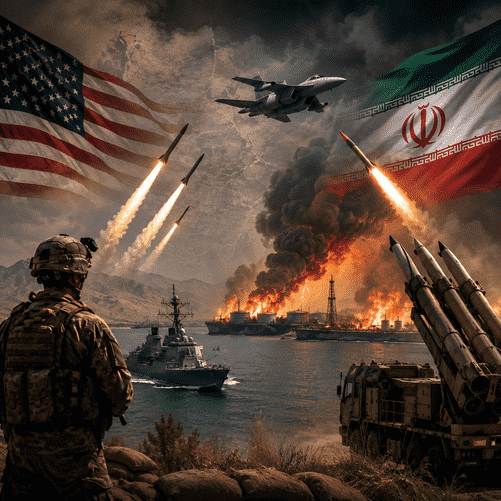
The uncertainty comes at a complicated moment for the U.S. economy. Inflation has cooled from recent highs but remains too elevated for comfort. The labour market is stable, though no longer overheated, while consumer spending and AI-related investment continue to support growth. At the same time, lower oil prices after the recent U.S.-Iran truce have eased one major source of inflation pressure.
Markets are divided over what comes next. Investors currently see only a limited chance of a July rate increase, but stronger growth or renewed inflation pressure could force the Fed to tighten later. Warsh’s comments offered no direct reassurance to either side. Stocks edged lower as traders searched his remarks for clues and found few firm signals.
For Warsh, the strategy carries both advantages and risks. By avoiding detailed guidance, he may give the Fed more flexibility and reduce the impression that policy is pre-committed. That could be useful in an economy shaped by unusual forces, including rapid AI investment, geopolitical shocks and shifting energy prices.
But less guidance can also mean more uncertainty. If investors cannot anticipate the Fed’s reaction function, bond yields, equities and currency markets may move more sharply around speeches, economic data and policy meetings. Warsh appears comfortable with that trade-off, believing that markets should not depend too heavily on central-bank signals.
His stance also reflects a deeper philosophical shift. Warsh has long argued that the Fed became too expansive after the global financial crisis, intervening too often in markets and communicating too much about its intentions. As chair, he now has a chance to reshape not only interest-rate policy, but also the institution’s relationship with investors.
The immediate question is whether the Fed raises rates this month. The larger question is how monetary policy will work under a chair who is determined to restore discretion, surprise and internal debate to the centre of decision-making.
For households and businesses, the stakes are practical: borrowing costs, mortgage rates, investment decisions and inflation expectations all depend on where rates go next. For markets, the message from Sintra was equally clear. Warsh may believe inflation risks have improved, but he is not ready to tell anyone how the Fed will act — and that uncertainty is now part of the policy itself.