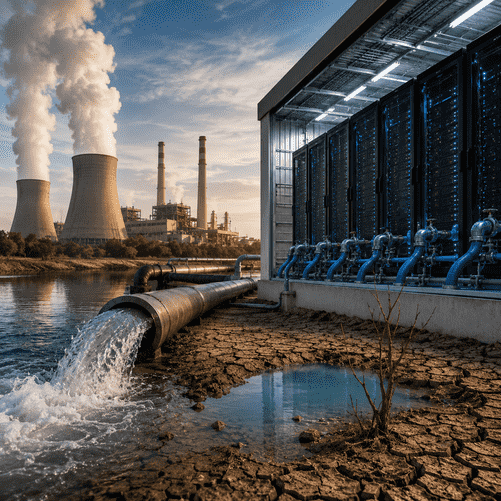
As companies race to build artificial-intelligence infrastructure, researchers and communities warn that the sector’s true water footprint is far larger than many corporate disclosures suggest.

The rapid expansion of artificial intelligence is forcing a new environmental question into public view: how much water does the digital economy really consume?
A new report has drawn attention to a gap in the way major technology companies disclose the water demands of their data centers. While firms often report the water used directly inside facilities for cooling servers, researchers say that figure can exclude a much larger source of consumption: the water used by power plants that generate the electricity feeding those same data centers.
That indirect use can be several times greater than the water consumed on site. According to the report, Google’s indirect water use linked to electricity generation was estimated at roughly three times its direct data-center water use, while Meta’s broader water footprint in 2024 was reported at about 19 billion gallons — far above the water consumed directly inside its facilities.
The issue is becoming more urgent as artificial intelligence drives a historic buildout of data centers. Training and running advanced AI models requires huge volumes of electricity, powerful chips and constant cooling. As servers become denser and hotter, operators must either use more energy-intensive cooling systems or rely on water-based methods that can strain local supplies.
Water is used in several ways across the AI supply chain: directly to cool data centers, indirectly to generate electricity and during the manufacturing of hardware such as semiconductors and servers. The UK Government Digital Sustainability Alliance has identified these three channels as central to AI’s water footprint.
The concern is not only global, but local. Data centers are often built where land, energy connections and tax incentives are available, yet those same regions may already face pressure on water resources. The World Resources Institute has warned that large data centers can consume as much as 5 million gallons of water per day, comparable to the daily demand of a small town.
By 2028, AI-related data centers in the United States alone could require up to 32 billion gallons of water annually, according to estimates cited by WRI. That figure does not fully resolve the question of indirect water use from electricity generation, which depends heavily on the local power mix and whether electricity comes from water-intensive thermal plants, renewables or other sources.
The problem is also tied to transparency. Many communities hosting proposed data centers say they are given limited information about how much water and electricity new facilities will require. In several U.S. regions, opposition has grown as residents worry that data centers could raise utility costs, intensify drought pressures or receive public incentives without delivering enough local benefits.
Technology companies argue that they are improving efficiency, investing in renewable energy and developing new cooling methods. Some facilities use closed-loop systems that reduce water withdrawal, while others are experimenting with liquid cooling, heat reuse and workload shifting to regions with cleaner or less water-intensive power grids.
But critics say sustainability pledges often fail to capture the full physical impact of AI infrastructure. A company may report low water use inside a data center while relying on electricity from power plants that consume large quantities of water elsewhere. That separation can make the environmental footprint appear smaller than it is.
The stakes are rising quickly. UN-linked researchers warned in June that AI data centers could sharply increase global electricity and water consumption by 2030, with water demand projected to reach trillions of liters annually if current growth trends continue.
For Big Tech, the water debate is becoming part of a broader accountability challenge. Investors, regulators and local communities are no longer asking only whether AI systems are powerful or profitable. They are increasingly asking where the electricity comes from, how much water is used, who bears the cost and whether the benefits of the AI boom are being matched by honest disclosure of its environmental price.
The next phase of AI growth may therefore depend not only on chips and computing capacity, but also on something far more basic: whether the industry can prove that its digital future is not being built on hidden water stress.