The group says it is ready to transfer civilian authority to a U.S.-backed Palestinian technocratic body, yet its refusal to unilaterally lay down arms leaves the future of Gaza’s governance uncertain.

Hamas has announced that it is prepared to hand over governing authority in Gaza to a U.S.-backed Palestinian administration, a move that could mark one of the most significant political shifts in the enclave since the militant group took control nearly two decades ago.
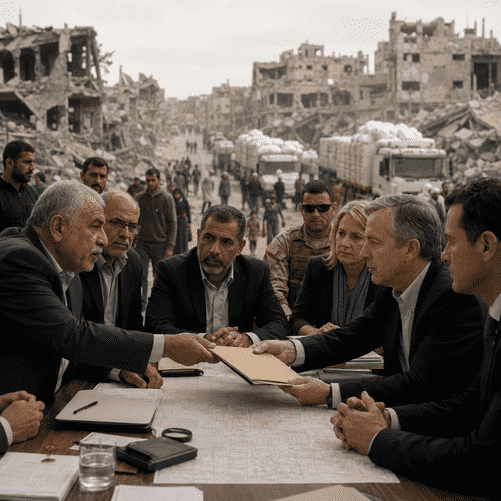
The group said it had dissolved its de facto government in Gaza and was ready to transfer civilian responsibilities to the National Committee for the Administration of Gaza, a body of Palestinian technocrats backed by Washington and linked to a broader post-war reconstruction plan. The committee is chaired by Ali Shaath, a former Palestinian Authority official, and is intended to manage humanitarian relief, reconstruction and public services during a transitional period.
The announcement appears designed to revive a stalled U.S.-supported peace framework and increase pressure on Israel to allow a new administrative structure to begin operating inside Gaza. Hamas has argued that it is willing to step aside from formal governance, but it has not accepted Israel’s and Washington’s demand that it disarm unilaterally. That unresolved issue remains the central obstacle to any durable political settlement.
Israel quickly dismissed the move as insufficient. Foreign Minister Gideon Saar described the announcement as superficial, arguing that any civilian authority formed while Hamas retains its weapons would remain under the group’s effective control. Israeli officials have repeatedly insisted that a post-war Gaza arrangement must include the dismantling of Hamas’s military infrastructure and the removal of its ability to govern through force.
The U.S.-backed plan has been under discussion for months. Earlier phases envisioned the creation of a temporary Palestinian technocratic committee, supervised by an international “Board of Peace,” to lead Gaza’s reconstruction and coordinate relief. The committee, however, has reportedly remained based outside Gaza, largely in Egypt, because Israeli restrictions have prevented its members from entering the territory and assuming authority on the ground.
The dispute over weapons has repeatedly stalled negotiations. Hamas has said it will not discuss giving up arms without guarantees that Israeli forces will fully withdraw from Gaza and that Palestinians will receive a clear political path toward statehood. U.S. and Israeli proposals have instead tied further Israeli withdrawals to Hamas’s disarmament, creating a sequencing dispute that neither side has been willing to resolve.
For Gaza’s civilians, the announcement comes amid continuing devastation and deep uncertainty. Large areas of the enclave remain under Israeli military control, reconstruction has barely begun, and humanitarian conditions remain severe. The proposed transfer of authority could help open a pathway for aid delivery and rebuilding, but only if Israel, Hamas, the United States and regional mediators agree on security guarantees and the practical terms of administration.
The move also raises difficult questions about Palestinian political legitimacy. The National Committee for the Administration of Gaza is described as a technocratic body rather than an elected government. While that structure may appeal to international mediators seeking a neutral transitional authority, it could face resistance if Palestinians view it as externally imposed or disconnected from broader national representation.
Hamas’s announcement therefore represents both a potential opening and a strategic maneuver. By offering to relinquish formal civilian control, the group is signaling flexibility on governance while preserving its leverage on security. Israel and the United States, however, are unlikely to accept a transition that leaves Hamas armed and influential behind the scenes.
The result is a fragile diplomatic moment. Gaza may be closer to a new governing arrangement than it has been in months, but the hardest question remains unanswered: whether Hamas is truly prepared to surrender power, or only to change the form through which it exercises it.